The Why Now Community Challenge: Veeam Data Platform 13.1. It’s time to vote!
News, guidelines and various community projects
Recently active
On of the large risks in IT isn’t just Ransomware, hardware faults, or even disaster recovery events.What happens when the person who knows how everything works quits? In many organizations, especially smaller ones, the Veeam Admin is not just responsible for dealing with backups and restores all day. Some of the tasks us Administrators do are:Windows Server Administrators Virtualization Administrators Storage Administrators Security Administrators Network Administrators Domain Administrators Cloud Administrators Disaster RecoveryYou get the point, we wear many hats, and have a lot of access and knowledge. Here are a few things you need to do in the case someone who is responsible for these items do. 1. Change Every password they knew.Veeam Service accounts, Repositories, Hypervisors, OS’s, Storage, Tape libraries, Storage arrays, Switches, Firewalls, Server management, Cloud accounts, Enterprise applications, Encryption passwords…. The list goes on and on, but you don’t know what was
From Veeam 12 to Veeam 13: Building a Future-Proof Backup & Recovery PlatformIn the coming period, we will take an important step in further strengthening our digital resilience. Our current Veeam 12 environment will be migrated to Veeam 13, based on the new Virtual Appliance architecture. At the same time, we will replace our existing, technically end-of-life backup hardware with a completely new infrastructure.For VNOG (Veiligheidsregio Noord- en Oost-Gelderland), cyber resilience is essential because our services directly support public safety and crisis response, where continuity really matters. VNOG is a regional public safety organisation responsible for fire and rescue services, we provide essential fire-fighting services and assistance in the event of accidents, disasters and crises to the 870,000 citizens of North and East Gelderland in the Netherlands.The new design is distributed across two data centres. Within our vSAN environment, which hosts approximately 180 Windows
Veeam Backup and Replication v13 on Windows includes an option to define a custom mirror repository. But what repository should you actually mirror? Is this option even intended for the windows based installation, cause it feels like the offical repos only host updates for the software appliance.
Once again we are in normal circumstances with a full docket of programming. @Madi.Cristil has picked out an awesome block of content that we have recapped, you can watch the video here: Featured Contentvia @EdwinMoraal via @Dynamic via @Stabz Vanguard Blog Spotlight - Stephen SeagraveThis week’s Vanguard Blog Spotlight comes from @Stephen Seagrave with the Frontline backup blog, discussing designs for insurance, business and more: Ransomware Insurance Requirements in Backup Design | FrontlineBackupSpecial Department Newsvia @Madi.Cristil via VUG New Zealandvia VUG BrazilNew Analyst Research: Enterprise AI Readiness: Data Controls and Recovery for AI Agents Enterprise AI Readiness: Data Controls and Recovery for AI AgentsWho’s NewThank you @safiya for prepping this week’s Who’s New, we are pleased to welcome +133 new members. The coolest usernames are @kraisy, @witzel, @ithelp and @gamer23. Alfred’s pick is @olimpias! Have a great weekend everyone.
I’ve been going through an AWS course recently, and while reading about S3 versioning, I was wondering how many times people look at versioning, backup, and disaster recovery thinking they solve the same problem.It’s a very common way to think about them, but once you start breaking it down, it becomes clear they operate at completely different layers.They all fall under the broader idea of data protection, but mixing them up usually becomes obvious when something actually goes wrong.Versioning (AWS S3 Versioning)This is the most immediate layer. I think in AWS, S3 Versioning answers a simple question: “Can I recover a previous version of this object?”If something gets overwritten or deleted, S3 keeps older versions so you can roll back.It’s fast, simple, and very effective for small mistakes — an accidental overwrite, a bad update, or a quick rollback.But it’s still operating inside the same system. Same bucket, same environment, same trust boundary.So it works well for object-level r
I got this number wrong on my first pass, so this post is partly a correction to myself. While fact checking a storage economics piece, I pulled the Block Generation figure from the unstructured data immutability page: up to 10 days added on object storage. Then I found the dedicated Block Generation page giving 30 for some providers. Same user guide, different answers, and a 20 day spread between the documented values. That seemed worth running all the way down. Short version: the feature is smart, the savings are real, and it's often missing from the capacity math I see.What Block Generation actually is Immutability on object storage is enforced object by object, and that creates a scale problem. A typical daily incremental reuses most of the blocks already sitting in the bucket. Veeam has walked through the math on the R&D Forums: at an ordinary daily change rate, nearly every block in a new restore point already exists in storage, so going back and pushing each one's lock forw
Grab your favorite drink — @Rick Vanover and I are back with another episode!We’re catching up on what’s been going on in the community and naturally ending up deep in a few interesting technical conversations along the way. This time that includes a browser-based VBR log analysis tool, what’s new with Kasten for Kubernetes v9 and OpenShift Virtualization, and a closer look at Subscription vs. Rental licensing.Always good conversations, always a few surprises. Happy weekend everyone! 💚 Featured Content via @Jason Orchard-ingram micro via @eprieto via @Andreas Buhlmann Vanguard Blog Spotlight via @benharmer https://benharmer.blog/2026/06/09/universal-cdp-how-to-protect-your-critical-workloads/#more-3158Special Department Newsvia @HunterLAFR via @Stephen Seagrave via @lukas.k , @CMF and Bradvia @mkevenaar and @JonahMay via @MatzeB and @ddomask via @Madi.Cristil via @Madi.Cristil Welcome to all Rising Star members! VeeamON Tour Italy 2026 Community Corner via @MarcoLuvi
It is hard to imagine modern IT environments without snapshots. They are quick to create, can be automated, and ideally to restore very fast to an earlier state. So it is no surprise that in day-to-day operations you often hear the sentence: “We have a snapshot — so we have a backup.” But is that really true?The short answer is: usually no. The slightly longer answer:A snapshot can be a very valuable recovery point. But only through independence from the production system, defined retention, copies to another medium, protection against manipulation, and reliable recoverability does it become a resilient backup concept. So, what actually is a backup? A backup is a separate, recoverable copy of production data, systems, or applications. Its purpose is to restore a defined state after data loss, corruption, user error, attacks, or infrastructure failures.What matters is not only that data from an earlier point in time exists “somehow”. A backup should primarily fulfill the following chara
Hi Community,Does anyone know the best way to backup the Nutanix Prism Centarl VM? Thank you!
Hi everyone,I have a question about using the proxy appliance as an internet proxy for VMs running inside a Veeam Virtual Lab.I enabled the internet access feature and configured HTTPS traffic on port 443. On a VM within the isolated network, I then configured the isolated-network IP address of the proxy appliance and the corresponding port as a proxy server in the web browser.However, internet access is not working.While troubleshooting, I started wondering how DNS resolution is supposed to work in this scenario. Typically, the VM sends DNS queries to an internal DNS server. If the requested hostname cannot be resolved locally, the DNS server forwards the query to an external DNS forwarder.Since the proxy appliance only proxies the web traffic, how are DNS queries from the isolated environment handled? Does the internal DNS server require a separate route or masquerading rule for external DNS resolution, or is DNS resolution handled by the proxy appliance as part of the proxy connecti
Hi everyone,I’d like to share a community project I have been working on: VBR Installer for Aliyun. https://github.com/Coku2015/VBR_Installer_for_Aliyun/The project provides a browser-based wizard for deploying a Veeam Software Appliance into your own Alibaba Cloud account. I created it to explore a more repeatable deployment workflow for Veeam users who operate workloads on Alibaba Cloud.The installer currently supports:VeeamSoftwareAppliance_13.0.2.29_20260617.ovaIt runs on Windows and macOS and requires Python 3.12+, QEMU (qemu-img), Git, and Alibaba Cloud CLI 3.3 or later.I have published a introduction and walkthrough here:https://blog.backupnext.cloud/en/2026/07/Veeam-Installer-for-Aliyun-launch/I would be very interested in feedback from the community.Thanks, and I hope this project is useful.
Hi everyone! I've been working in the lab on some Kubernetes deployments using MobaXterm Home Edition and Rancher. I started off using PuTTY, but found that it could be limiting for what I needed. So I began my hunt to find the best SSH client, and I ended up landing at MobaXterm. In this post, I want to talk a bit about why I opted to use MobaXterm and all of the great features it offers, especially pertaining to working with Kubernetes. Intuitive UI and Easy to NavigateWhile evaluating alternatives to PuTTY, I found that PuTTY along with other SSH terminals looked a bit dated and less approachable. Since this was my first time doing this much terminal-focused Kubernetes work, I wanted a tool I could easily navigate to reduce friction. MobaXterm has a very sleek interface that lends itself nicely to beginners and experts alike. 15 Session Settings/OptionsMobaXterm supports a wide range of session types (SSH, Telnet, RDP, etc.), which makes it useful as a single tool for connecting to
Setup:On-prem VBR 12.3.2 Veeam Backup for Microsoft Azure appliance, connected via External Repository Goal: Instant Recovery to VMware vSphere, restoring Azure VMs back to on-prem vCenter (testing DR failback scenario)What I've confirmed:Restore points ARE visible in VBR under Home → Backups → External Repository → Failback storage Each VM already shows 5 restore points. Platform shows correctly as Microsoft Azure, repository FailbackThe issue:When I right-click a restore point to start the recovery, "Instant Recovery to VMware vSphere" is not available / grayed out in the menu, even though the restore point is clearly present and shows 5 valid points.Questions:What conditions cause Instant Recovery to VMware vSphere to be unavailable even when a valid restore point is shown in the console? Does an active/running backup job on the same policy (I currently have other jobs running in parallel) block Instant Recovery for these VMs? Are there specific requirements for restore points impor
Hello,We are facing a backup issue with Veeam Agent for Microsoft Windows on one specific Windows 11 Pro workstation.We have two Windows 11 Pro PCs, both fully updated and both backing up to the same SMB share.On PC #2, backups work fine.On PC #1, backups always fail.The job starts normally and goes through: Initializing Preparing for backup Creating VSS snapshot Calculating digests Reading EFI partition Reading OS (C:) The failure occurs during Finalizing with the following errors: Application is shutting down. Unable to retrieve next block transmission command Exception of type 'Veeam.Backup.AgentProvider.AgentClosedException' was thrown What we already tried: Reinstalled the agent Recreated the backup job Updated the agent to 13.0.2.1102 Disabled antivirus for testing Confirmed SMB 3.1.1 Added this registry key:HKLM\SOFTWARE\Veeam\Veeam Endpoint BackupForceBufferedAccess (DWORD 32-bit) = 1 We also checked VSS earlier: writers are stable and the backup does not
I'm documenting a full move from VBR v13 on Windows to the v13.1 Software Appliance, run for real in my Pure Storage lab before any of it gets called a production map. Part 2 of the series just went up, and it's the architecture conversation, so I wanted to share the highlights here where the architecture arguments actually happen.The premise: the worst time to make design decisions is mid-migration. The appliance model changes enough old defaults that the target deserves a fresh sheet of paper, not a copy of what your Windows server had. Here's what ended up on my sheet.The backup server is now an appliance you don't log into. The VSA gives you a hardened, Veeam-managed Linux base with no OS access, and after years of preaching simplicity I find that liberating rather than scary. An OS I can't touch is an OS I can't break, and one an attacker finds much less interesting. The old placement rules still apply though: keep the control plane out of the blast radius of what it protects.Pr
Why this guide? A while back, a customer asked me for a simple step-by-step guide for restoring the Veeam Backup & Replication configuration onto a newly deployed Veeam Software Appliance. This write-up is the result. It has been a little while since then (as you can tell from the version used, 13.0.1) - but since I haven't found a similar step-by-step guide here in the Community Hub yet, this one is for you. I am well aware that most of the steps here are self-explanatory for all of us, and that most of you could get through this configuration blindfolded. My customer, however, asked for a truly foolproof guide - something to provide a rough direction in a worst-case scenario. That said, should it ever come to that, we will of course be supporting them anyway...And finally, the customer also receives a checklist to document the individual steps - you will find it at the end of this guide. VBR / Veeam Backup Server Configuration Restore If the entire Veeam VBR intelligence is no
Have you ever wondered where we Veeam 100 members are distributed around the world?Based on Veeam 100 Directory | Veeam Community Resource Hub and the public location information I have from our LinkedIn profiles, I sat down and provided a world map that answers exactly the above question, or shows it on the map. In the backend, I use MapGeo and Google Sheets for this. As soon as you press directly on a member or their point on the map, the photo stored from the Veeam 100 Directory (in the Community Hub) opens.For short information such as names, titles and, if applicable, Blog URL just “hover” over the point on the Map. Below the map is a search mask, here you can jump directly to the corresponding member, which also opens the stored profile picture (see above). If you want to continue searching, just click outside the photo. Now only @safiya, @Madi.Cristil, @NikolaPejkova, @HannesK and @Rick Vanover need their own category in the Veeam 100 Directory with a photo, so that I can
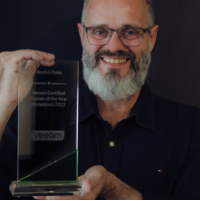
Well... you definitely didn't make this an easy one. 😄 June was packed with great articles. Thank you to everyone who read, voted, and supported your fellow community members!A big round of applause to @Jason Orchard-ingram micro , whose article A free browser-based tool for reading review the VBR environment it uses the VMC.log got the Blog of the Month title for June 2026! Congratulations, Jason, and big thank you to everyone who keeps sharing knowledge, experiences, and tips with the community. Every post helps someone learn something new—and that's what this community is all about. 💚
Recently, one of our clients experienced a situation that perfectly illustrates why operational resilience must be at the heart of every IT strategy regardless of any external threat.📖 The ScenarioWe were in the middle of building a new infrastructure, which was not yet operational, when the client suffered the loss of both server rooms within 48 hours of each other.The cause? Not ransomware. Not an intrusion. Simply the simultaneous end-of-life of SSD drives after nearly 8 years of operation.The tiered storage architecture amplified the impact: as soon as the SSDs reached their endurance limit, the first site collapsed overnight. Investigation quickly confirmed the diagnosis. But the second site, running the same architecture with the same history, followed the same path two days later.Bad timing? Absolutely. ⚙️ The Operational ResponseThe situation was all the more complex as the production infrastructure was end-of-life and out of support, we were precisely in the process of buildi
Even though I am on vacation this week and next still need to keep up with the blog series of 10 in 10 weeks. For week four we discuss the VSA and operational changes. You can find a link to my blog and the article below.Blog - Veeam Software Appliance: What Changes Operationally Veeam Software Appliance: What Changes Operationally Introduction The Veeam software appliance is one of the more important operational shifts in the v13 release. It changes the conversation from simply installing backup software to managing a more controlled platform with a tighter lifecycle and a more opinionated security posture.That matters in production because backup teams are often measured by consistency more than flexibility. A platform that reduces configuration drift, narrows the administrative surface, and standardizes maintenance can improve reliability, but it also changes how teams troubleshoot and support the environment. Deployment Changes Traditional deployments often inherit whatever stand
Hi everyone,Veeam Advisor v2.0 will be available tomorrow. For anyone who hasn't come across it before, Veeam Advisor is a free browser-based tool that reads a VBR diagnostic log (VMC.log) and turns it into a health report you can actually read. It covers things like sizing, licensing, configuration reviews, best-practice checks, and a bunch of other useful information.It's a single HTML file, so there's nothing to install, and all analysis happens locally in your browser. What's new in v2.0?@Dynamic Thanks for the suggestion about new color scheme, Ive gone with a more retro game vibe. The biggest addition is a new Resiliency Map.Upload a VMC log and it generates a visual view of your backup environment, showing backup jobs, repositories, and how data moves through backup copy jobs.I originally built it because I wanted an easy way to answer questions like:"Where does this backup actually end up?"or"Do we really have a second copy of everything?"Seeing it as a diagram makes a lot of
Recently, a customer came to me with what seemed to be a simple question:“Our Veeam Enterprise Manager can suddenly no longer properly connect to the Veeam Backup & Replication server, and the Catalog Service no longer synchronizes. But nothing was changed. What could be the reason?”Ah, the famous IT words: Nothing was changed.Of course, I basically understand what is meant by that. But it does not necessarily mean that a person changed something. Maybe a process, an automation, an update, a migration, etc. changed something. And of course, it is also possible that another person changed something without informing anyone, or that you changed something yourself but do not remember it anymore — or you do not see the impact because, at first glance, it does not seem to have anything to do with the issue.Well then, time to roll up our sleeves and go through the checklist:Was there a Veeam update?No Was there a configuration change in Veeam Backup Enterprise Manager or Veeam Backup &am
Yesterday I got an error for two oracle databases which are backed up via the VEEAM RMAN plugin.Strange - there are several database instances on this system, all but the two are working fine. And these two had worked up to then, too…And… I did not change anything in the VEEAM and plugn configuraton After some discussion and research with our Oracle admin - bingo.He had moved these two databases to another Home directory and did not change the corresponding entries in the /etc/oratab. So - as shown in the picture - the backup of the database and the recovery logs worked, but the creation of the AUTOBACKUP failed and the ORA-01012 error was given.After the entries were corrected all worked fine again.Perhaps some of you will face similar issues, too. I did not find anything for this problemin the forums with a quick search.
Hi everyone,I would like to share a troubleshooting case that took me a few long days to resolve. I hope this can help someone facing a similar issue in the future.The scenario was a VAW deployment to a customer Windows Server.At first, the issue looked like a standard deployment or Windows Installer problem. The Veeam Backup & Replication server was able to reach the target server and upload the MSI package, but the Agent installation never completed.The target server was also a bit unusual: it was heavily used through Remote Desktop sessions, with more than 60 users logged on. Because of that, it was not always easy to know if another MSI installation was really running, and we also had to perform all troubleshooting outside business hours. First issue: another installation already in progressThe first error we saw from the VBR console was:01/06/2026 22:34:43 Failed : [172.16.254.120] Installing package Veeam Agent for Windows Error: Another installation is already in progress. A
The ChallengeYou did everything right. You planned the maintenance window, cleared the pre-flight checks, upgraded your Veeam Backup & Replication server to v13, and expected the usual smooth ride when pushing the updated Veeam Agent to your protected workloads. Instead, the Protection Group rescan throws certificate errors, some of your agents stay on the old version, and your backup jobs on those endpoints start to look nervous.I ran into exactly this on a customer environment recently, and since the root cause was neither obvious in the logs nor documented in an easy-to-find KB, here is the short write-up. The Symptom(s)After the VBR upgrade to v13, the console tries to push the new Veeam Agent binaries to the Windows guests in a Protection Group. The deployment fails with a certificate related error, typically along the lines of:A certificate chain processed, but terminated in a root certificate which is not trusted by the trust provider. Or a signature verification failure on
Already have an account? Login
Enter your E-mail address. We'll send you an e-mail with instructions to reset your password.