The Why Now Community Challenge: Veeam Data Platform 13.1. It’s time to vote!
News, guidelines and various community projects
Recently active
Details: Files visible: Central_AD.vbm → metadata/config fileCentral_AD2026-06-01...vbk → Full backup (~73 GB ✅ normal)Central_AD2026-06-02...vib → ~2.4 GBCentral_AD2026-06-03...vib → ~2.6 GBCentral_AD2026-06-04...vib → ~2.1 GBCentral_AD2026-06-05...vib → ~2.5 GBCentral_AD2026-06-06...vib → ~2.5 GBCentral_AD2026-06-07...vib → ~1.5 GB👉 These .vib files are incremental backups (daily changes only)Hello Veeam Community,I am using Veeam Agent for Microsoft Windows free for office use, with no big data exchange, and noticed that the incremental backup (.vib) files for a single machine are relatively large (around 1.5 GB to 5.6 GB per day), while the full backup is about 73 GB. Machine details: - Role: Active Directory server (Central_AD) - Backup type: Incremental (daily) I would like to understand:1. Is this incremental size normal for this type of workload?2. What factors could cause such daily change rates?3. Are there recommended optimizations to reduce incremental backup size?4. How
Hi,We have a client which has Veeam Windows Agent free edition version 13 installed. The agent back up to a local USB disk. Now the client would like to have a second job to back up to our Veeam Cloud Connect console.However we still have VSPC version 8.1.0.21999 installed and our Cloud Connect Server is at level 12.3.3I know ideally we should upgrade our infrastructure to version 13 and also the VSPC console. Question is: Is it possible to add the client with the new Windows agent to our VSPC without needing to downgrade the Window agent? Ideally I’d like to install the management agent to the client laptop and use the already installed Windows agent which converts to a license version and install the second job to back up to the data center.I don’t like the idea to upgrade the infrastructure in a rush for that client.Thanks,
They want a detailed description but truncate it at about 2.000 characters :("Provide a detailed issue description and error messages." field does not accept more than that.Usually I prepare my issues in text editor and in the end copy/paste into support portal.Now I realize only half of it made it through while I don't have my original any more.I'd expect the GUI at least to give a warning. Noone serious will type his message into some web form initially and realize the input no longer works as he’s typing live.Who can fix that? Open a case for it? ;)
Hello. I am a single user, and I have a Windows 11 Home mid-range gaming PC with a 1 terabyte internal SSD for personal use. I presently have Veeam Agent for Windows (free edition, can do only one job at a time). It was 176 megabytes. It backs up my filesystem to an external 1 terabyte mechanical hard disk. There are no virtual machines here. I figured out how to use Agent without problems. It works like a charm. Set and forget. I want to add a second job, being a whole-volume-to-external hard disk job. But the free version of Agent can’t do two jobs for free. In fact, I wouldn’t mind a third job, which is to backup my most sensitive files more often. I would buy a license for Agent, but they’re only available in the UK in packs of 5! I downloaded Backup & Replication Community Edition, which is 17.9 gigabytes. It is said to allow up to 10 jobs at once. It is obviously much more powerful and gargantuan than Agent. I can’t figure out how to use it. I don’t have a separate server. I
How do I create a recovery USB drive using Veeam Backup & Replication Console 13?The methods described online and by the “Veeam Intelligence” agent don’t work for me.
Hi all,I’m getting the above error trying to install components on my managed physical server for Veeam 12.3 . I proceeded to manually mount the iso on that server and install the components myself, but still getting the error. I’ve checked and the Remote Procedure Call (RPC) windows service is running fine.Installed the Veeam VSS Hardware Snapshot provider and checked the Registry - all present.Checked logs for the transport service at ‘C:\ProgramData\Veeam\Backup\Svc.VeeamTransport.log’ on the managed server, and seems to connect fine with agent. Did a configuration backup and performed a clean install of the backup server as some other posts suggested but still getting the error.Not sure if a clean install should be done on the managed server as well.. but not sure what else to try either. Any suggestions will be greatly appreciated. Thanks.
Hello everyone,I am using Veeam Agent for Microsoft Windows Free and am currently facing issues restoring a full computer backup. At this point, I have run out of ideas and hope that someone in the community can help.EnvironmentI have a PC that was protected with Veeam Agent for Microsoft Windows Free. The backup job was configured to perform a full computer backup and store it on an external HDD.Recently, the PC's Intel Optane SSD failed and had to be replaced. After installing a new SSD, I attempted to restore the system from the existing Veeam backup.ProblemWhen I start the recovery process and open Volume Level Restore, Veeam does not automatically detect the backup. However, I am able to manually browse to and select the backup files (see attached screenshot). After selecting the backup, nothing happens. When I click "Next", I receive the following error message:InvestigationAfter spending quite some time troubleshooting and reviewing the logs, I inspected the .vbm file manually.
Hello everyone, I am trying to connect the Veeam software appliance and my NAS via iSCSI. It won't work directly, so I installed Veeam Infrastructure Server, where I tried to connect the NAS, but I have no idea how to connect it there. I looked through the documentation, but couldn't find anything. Could you please advise me?Thank you in advance.
Ransomware and data attacks are everywhere and, unfortunately, have become part of daily life. A very practical protection against this is the proven Veeam 3-2-1-1-0 rule: multiple copies, different media, at least one copy external/offsite, and one copy immutable/offline, with 0 restore errors ensured by regular testing.However, once you plan to use and implement immutability, you also need to look at the storage logic of your backup data—in other words, how full backups and incrementals are linked together as a backup chain. Depending on the method, these chains may need to merge, transform, or create new full backups in the background. It’s only logical that this doesn’t always align perfectly with Immutable/WORM.To make immutability and retention work together cleanly in practice, you typically use regular full backups (Synthetic or Active) and/or, in Backup Copy jobs, the GFS function as a “chain breaker”. In this article we’ll look at:what immutability means how different backup
We are using Veeam Data Cloud Vault for offsite copies of our backups. When I look at the copy properties in VBR console, I see under the “Immutable Until” column a whole lot of restored points that say Expired with a date in the past. What does this mean?If they are expired does that mean I can delete them and if so, how would I do this?Many ThanksRoy
in this configuration we run daily incrementals (Monday thru Friday) to disk (Linux Repository)on Saturday Morning (just after Midnight) we start our Tape Backups job,(there is only 1 job that looks at the entire repository) it is a GFS job that Generates synthetic full backups for Weekly / Monthly retention. the HP Library target contains 2 LT08 Tape drive that are streaming at about 540MB/Sec. This would probably be acceptable with the exception of one 42 TB file server (starts about 1/3 of the way through the job and grabs one tape drive for 50 Hours+.) This causes the Overall tape Backup to run up to 76 Hours. Spilling into the next days incremental Jobs. I’m considering a change to the Daily’s Backups jobs to have them Generate Weekly Full backups on the repository, and then use Tape Copy Jobs to move the Full backups to tape? is it worth the effort? is it Supported?
The phone rings and someone asks you to restore a file for them. You look at your furthest restore point and notice the date they gave you is before that. You restore the file anyways and find out it was off by only a few days. What do you do? Do you give up, or do you check to see if there is something running keeping data for just a little bit longer? Many users forget that windows can take VSS Snapshots, ShadowCopies, and restore points that often hang around, or are even automated to run. Depending on how much space is provisioned determines how many you can have and the retention. These snapshots can even help during Veeam restore by sneaking out a few extra weeks from what you thought was the furthest restore point in your environment. Lets start with the basic commands on adding VSS Shadow Storage on your disks. This is a per drive setting, and it is also selecting the target drive. In this command, I’m keeping it on the same drive, allowing 5% of my disk to store shadow
I upgraded to Veeam 13 a few weeks ago. I finished adding my 2.5G network and VLANs on Thursday. My Ubuntu 24.04 servers are backing up fine. Veeam 13 in my workgroup wants certificates now. I had to spin up a Windows 2022 Standalone CA to create certificates for all Windows 10 and 11 workstations. I will be creating the workstation certs from it today and installing them. Any suggestions on getting Windows 11 to backup? I hope the cert does the trick. 2.5G network is much faster. I will post numbers tonight.
I want the Hyper-V VMs backed up to restore each of the 6 (600GB+)I want the Windows 2022 Standard Server to be bare metal recoveredWhat is the best way of doing it?
Previously, we were able to CTRL+C rows from the Tape Infrastructure tab and paste them into an Excel sheet for tracking. Now when copying the rows and pasting into Excel, it results in empty cells. Pasting into notepad and other text editors shows blank spaces as well. Is this some sort of bug that anyone else is experiencing?
Could you please help with the script in powershell to fetch the backup health check / maintenance schedule for backup jobs and the status or can this be fetched from Veeam ONE ?
Quick question.How do I view the attachments that I previously uploaded to a case?Just to make sure they're there.I have a feeling attachments from my email responses do not get attached to the case (although noone reacts on it even though I explicitly refer to those filenames) I’m asking because I had a Zoom session with one of the support guys and he only looked at my screen for a second before telling me how to proceed, however it was the exact screen I already attached to one of my responses as an e-mail attachment.Thanks.
Someone can help me to understand how forward forever incremental work on immutable storage?Example the retention set to 7, the immutable period set to 7 days, block generated is 10 days and the source job with ‘no periodic full’ configuredThe time line is :Day 1: full backup Day 2 - 16 : incremental Day 17 : Day 1 full backup will be expired and can be deleted. Will veeam delete this point since the retention is over? If yes then how we can restore if there no full backup? Or will full backup merged with 2nd incremental, but 2nd incrementall still in immutable.
Greetings friends,I wanted to share a new community-driven PowerShell report for Microsoft Entra ID protection in Veeam Backup & Replication.VBR can protect Microsoft Entra ID, which is great. But I wanted a cleaner way to answer a few simple questions without jumping between logs, CSVs, SQL queries, or job sessions.This is how it looks like: Why this report?Microsoft Entra ID is now one of the most critical identity layers in most organizations. It contains users, groups, applications, service principals, role assignments, conditional access policies, and many other objects that are essential for Microsoft 365, Azure, SaaS access, and automation.Having the backup is step one.Being able to report on it, search it, export it, and send it to the right people is the next step.This report helps answer:Are my Entra ID backup sessions running successfully? What completed with warnings or failures? How many objects were discovered and stored? Which users, groups, applications, service pri
Today while I was working in the Veeam Windows Console for v13 I hit a strange error when copying a job error message to the clipboard. It let me paste but the error noted is just a minor annoyance. I have reported this and you can read it below and on my blog. Once confirmed I will update things on the community and my blog post.Veeam Console – Possible BUG – Copying to Clipboard Veeam Console – Possible BUG – Copying to Clipboard I have been using Veeam v13 more frequently lately, particularly the VSA and the Windows Console application. Today, I encountered an unusual issue with the Console application while copying an error message from a job to the clipboard for investigation. The message below appeared, but I was still able to paste the clipboard contents regardless.Copy to Clipboard Error (Potential Bug?)I have posted this in the Veeam 100 thread (not everyone will see this, as it is a special section of the Forums) as a possible bug, which you can see here if you have access
Hi folks,If some of you have already try to delete a S3 bucket from the Object First interface you probably got the following error, even if you have delete all backups. S3 protocol does not allow deleting the bucket that contains any objects. In case the bucket was already in use, it should be cleared before deleting.Good new ! There is an utility to delete all the data from a bucket, including buckets with enable versioning.😮Oh god ! What could happen if I have some backups protected with immutability ?Don’t worry, in case if the bucket has immutable data, it can not be deleted before the immutability period is expired. 💪 1. Installationclear-bucket utility does not require installation.Download it with Web browser using the following link: https://repo.objectfirst.com/helpers/clear-bucket.zip Unpack the zip file2. UsageStart the clear-bucket.exe program as usual. It interactively requests the information required to connect to S3 storage Endpoint URL: use the same format you use
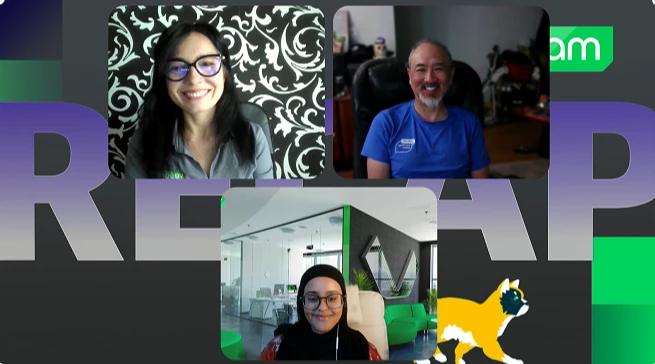
While @Rick Vanover was attending VeeamON Tour in Munich and enjoyed his time with our German community, I was joined by special guests, @safiya and @HangTen416 for a good discussion covering the latest community highlights and a range of technical topics. This episode features a fun look at VeeaMatrix—the Veeam-themed Matrix screensaver nobody asked for (but everyone needs)—alongside a real-world lesson on hidden data center risks and governance failures. Plus, the team shares the exciting news that the VMCE+ certification is now live.Featured Content via @Dynamic via @matheusgiovanini @Federica Vanguard Blog Spotlightvia @mhmdadl Veeam Kasten for Kubernetes v9.0 Special Department NewsVeeamON Tour Istanbul Community Corner via @kenanakcan , @Bulent.Tolu , @DChiavari and special thanks Burcin ! VeeamON Tour Munich Community Corner via @CMF , @Michael Melter , @tm67 , @Dynamic , @falkob , @Mildur , @regnor, @JailBreak , @MarvinMichalski , @MatzeB and all
One consequence of the market changes resulting from Broadcom VMware's new positioning of its software solutions and licenses is that the topic of “hypervisors” is now being analyzed in greater technical detail than ever before.In search of more realistic alternatives that fit IT departments’ budgets, organizations are turning their attention to market options.On the other hand, there is the open-source software community. I truly have a great admiration for the thousands of programmers, engineers, and software architects who dedicate their efforts to free software communities.Today, alternatives to the VMware hypervisor are solutions built on a stack of open-source projects, with varying degrees of customization and architectural differences.The purpose of this post is to analyze how a generic hypervisor architecture, based on QEMU and KVM, handles disk write I/O requests.It´s a fascinating topic (at least for me).Let’s explore the rationale behind the development of each component of
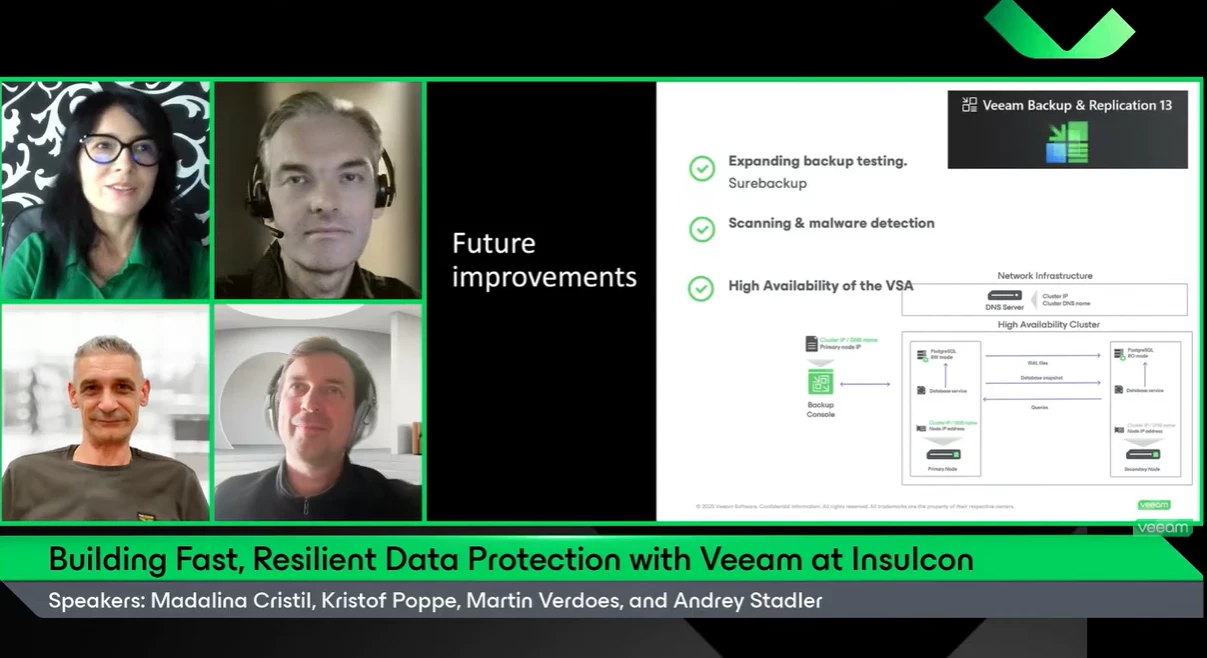
What a great Veeam 100 Show we had! A huge thank you to Martin, @kristofpoppe and @Andrey Stadler for the discussion on Insulcon's data protection journey. It was great to hear how Insulcon have relied on Veeam for many years and how they continue to evolve their strategy to strengthen resilience and stay ahead of emerging threats.I always enjoy hearing real customer stories and learning how organizations are putting technology into practice to solve real-world challenges.Thank you for the insights and the authentic discussion!
Veeam Backup & Replication 13.0.2 has officially landed.While this isn't a feature-heavy release, it is an important one from a security perspective, addressing a couple of recently disclosed vulnerabilities.For those already running V13, I'd recommend taking a look at the release notes and planning the upgrade.Curious to hear from the community:Have you already upgraded? Any observations from your lab or production environments? What's your typical process for validating VBR updates before rollout? Any advice for the ones that are planning to upgrade?Let's discuss!
Already have an account? Login
Enter your E-mail address. We'll send you an e-mail with instructions to reset your password.