


During the World Cup, Kasten scores goals like Messi

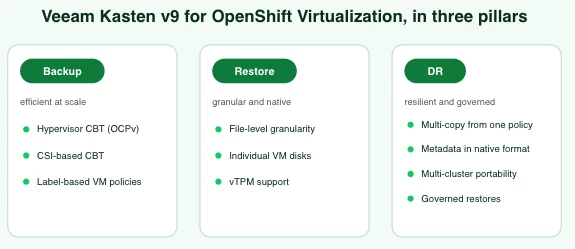
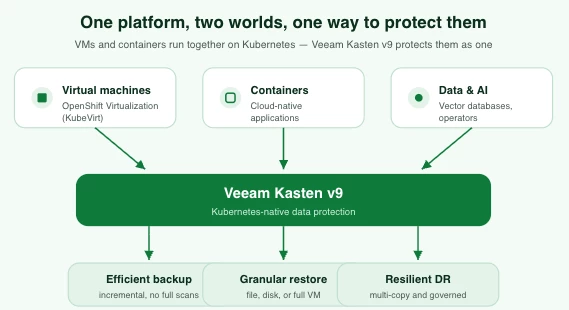
More and more teams are running virtual machines and containers side by side on the same Kubernetes platform. OpenShift Virtualization (KubeVirt) has made that a practical, production-ready reality — and Veeam Kasten for Kubernetes v9 makes sure data protection scales right alongside it. This release brings efficient incremental backups, granular and VM-aware restores, and resilient, governed disaster recovery to OpenShift Virtualization environments.
Efficient backups built for VMs
The centerpiece of this release for virtualization environments is the work done with Red Hat on incremental efficiency.
OpenShift Virtualization Incremental Backup API
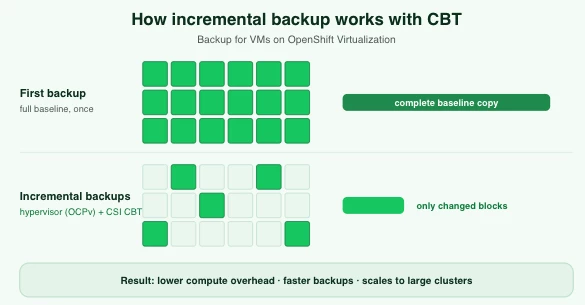
Kasten v9 supports Changed Block Tracking (CBT) at the hypervisor level through the new OpenShift Virtualization APIs. Instead of reading entire disks on every run, it captures only the blocks that changed. The direct payoff is lower compute overhead, shorter backup windows, and the ability to scale VM protection across large clusters while keeping the backup footprint clear of production workloads.
CSI-based CBT
Beyond hypervisor-level tracking, Kasten v9 offers Changed Block Tracking based on CSI that applies to both VMs and containers. This delivers storage-agnostic incremental backups across mixed workloads, so containers and KubeVirt VMs benefit from the same efficient approach.
Label-based VM policies
VM selection no longer has to be namespace-by-namespace or VM-by-VM. With Kubernetes label-based policies, virtual machines are protected dynamically by label match. In practice this means SLA-driven automation: a new VM that matches the label is protected automatically, with no manual step and no coverage gaps. It is one of the biggest reductions in operational effort in this release.
Granular, VM-aware restores
A backup is only as good as its restore, and Kasten v9 broadens recovery coverage for VMs considerably:
- File-level granular recovery. Native and automated — recover individual files without restoring the entire VM.
- Individual VM disk recovery. Fine-grained control over exactly what you bring back, rather than an all-or-nothing restore.
- vTPM protection and recovery. Full vTPM support, so workloads that depend on a virtual TPM (for security or operating-system requirements) come back ready to boot.
Together these capabilities bring the enterprise-grade recovery experience that administrators expect to OpenShift Virtualization.
Disaster recovery: the big step forward
Disaster recovery is where Kasten v9 stands out for OpenShift Virtualization, because it combines copy resilience, portability, and governance.
Multiple copies from a single policy
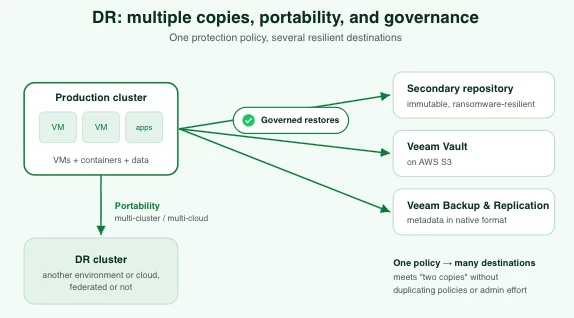
Kasten v9 can send exported backup data to an additional location from the same protection policy. This meets the "two copies" requirements common to compliance and ransomware strategies without duplicating and maintaining parallel policies, which reduces configuration sprawl and admin effort. (Export to multiple locations is available as a tech preview, with a few exclusions worth validating during POC design.)
More cloud destination choice
Export now includes Veeam Vault hosted on AWS S3, expanding storage options and aligning with AWS-first strategies and with region or compliance needs. Freedom to choose storage and export targets — including the Veeam ecosystem — without lock-in remains a core strength of the platform.
Metadata in native Veeam format for more reliable restores
A key DR improvement is the ability to export Kubernetes metadata to Veeam Backup & Replication (VBR) in native Veeam format, storing complete Kubernetes backups. This reduces reliance on external metadata stores, simplifies architecture, and improves backup portability and restore reliability. It answers a critical DR question directly: when you export a backup, where does the restore metadata live, and is it available the moment you need to recover?
Portability across clusters and clouds
For DR, test/dev, and migration scenarios, Kasten mobilizes applications and VMs across namespaces, clusters, and clouds, and migrates seamlessly between federated and non-federated clusters. That portability is what turns a backup into a real recovery plan rather than just an archived copy.
Governed restores
Recovery is governed too. Kasten v9 extends admission controller enforcement (Kyverno / OPA Gatekeeper) to Actions and RestorePoints, not just backup schedules. This lets you codify rules such as "no restore unless the destination is approved, immutable, or ticketed," applying to recovery operations the same controls that govern any Kubernetes change. Combined with hardened pods using read-only root filesystems (aligned with NIST 800-190), the recovery platform itself keeps a small attack surface.
Centralized visibility
Integration with Veeam Data Command Center provides a single view of backup coverage, risk, and audit readiness across multiple instances and clusters. For teams managing a growing fleet of VMs on OpenShift Virtualization, this turns posture assessment into consolidated evidence rather than cluster-by-cluster review.
All summed up in one photo