

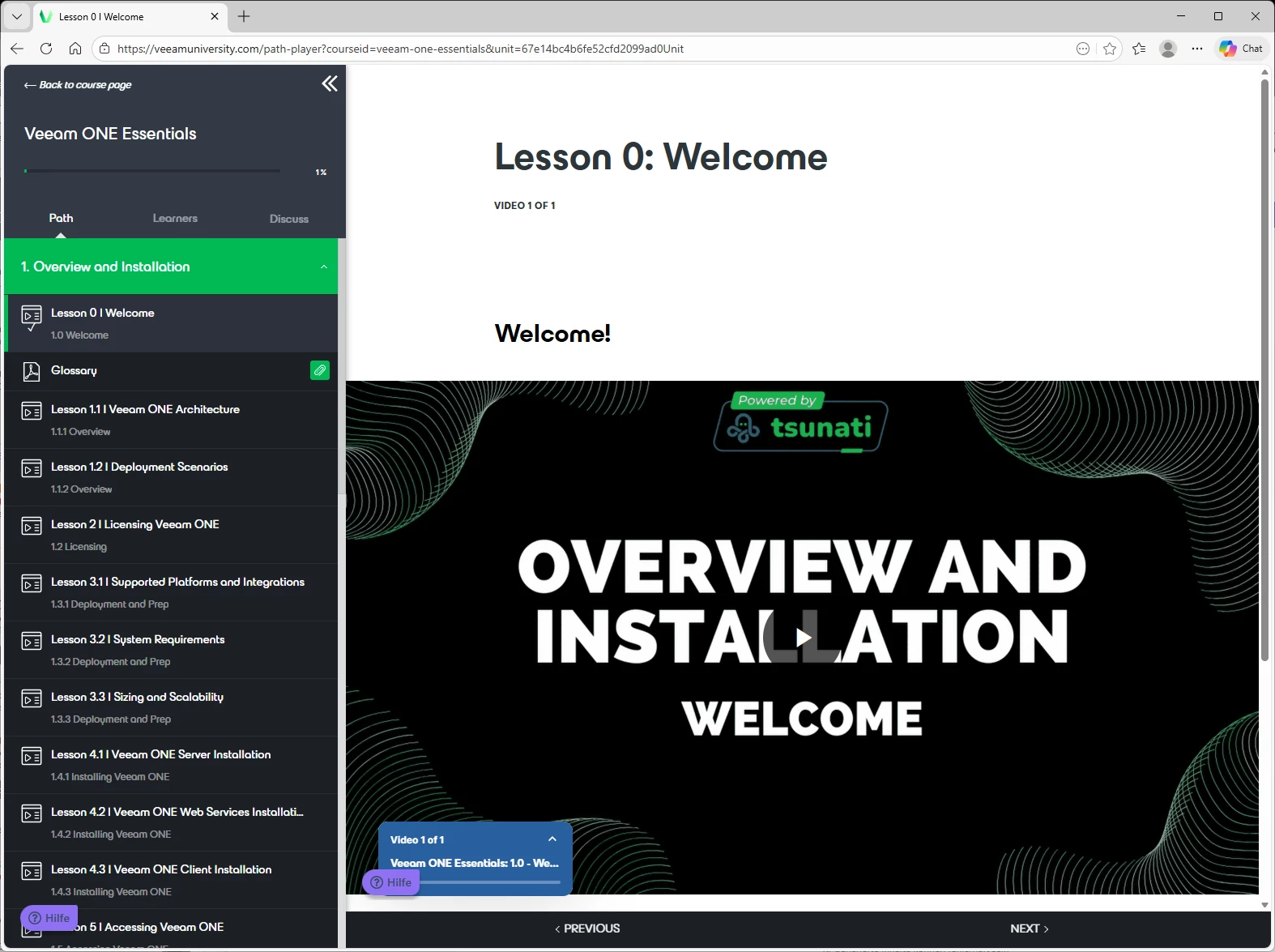
Today I’m officially onboarding to the Veeam ONE v13 training, which was released just about two weeks ago:

Getting to this point took a bit longer for me than expected, mostly due to a small but important realization: veeamuniversity.com is not the same platform as veeamuniversity-pro.com.
After some confusion and a few failed login attempts, it finally realized that I had to setup a new account on the non-PRO platform, because in my company we already had one for the PRO platform that did not show the course for me.
Once that was sorted out, login worked instantly and the path was clear to start the training today.
The timing couldn’t be better, as the relevance of Veeam ONE training has increased significantly.
With Veeam deprecating the classic VMCE certification, the new VMCE+ certification has taken its place.
This new certification path now explicitly includes Veeam ONE and Veeam Recovery Orchestrator, making monitoring, analytics, and orchestration first-class citizens in the Veeam ecosystem.
That shift reflects what many of us see in real-world environments: backup alone is no longer enough.
I’ve been working with Veeam ONE for years now, both operationally and architecturally.
It has become a central tool for capacity planning, performance troubleshooting, and proactive monitoring.
Still, every major release brings changes that are easy to miss when you’re focused on daily operations.
That’s exactly why I’m excited about this training, especially with a focus on what’s new in v13.
I’m particularly interested in improvements around analytics, alerting, and integration with modern platforms.
Understanding how Veeam ONE evolves alongside VBR and Recovery Orchestrator is key for designing resilient environments.
This training feels less like a checkbox and more like an opportunity to recalibrate how I use the product.
It’s also a good moment to challenge long-standing habits and assumptions.
Over the coming days, I’ll work through the modules step by step.
I plan to follow up with my experiences, findings, and practical takeaways from the training.
Some of them will likely confirm what I already know, others may change how I approach monitoring entirely.
Either way, this feels like the right time to dive deeper again.
More to come as the training progresses.