



The ultimate test of cyber resilience: recovering when all you have left are your backup files
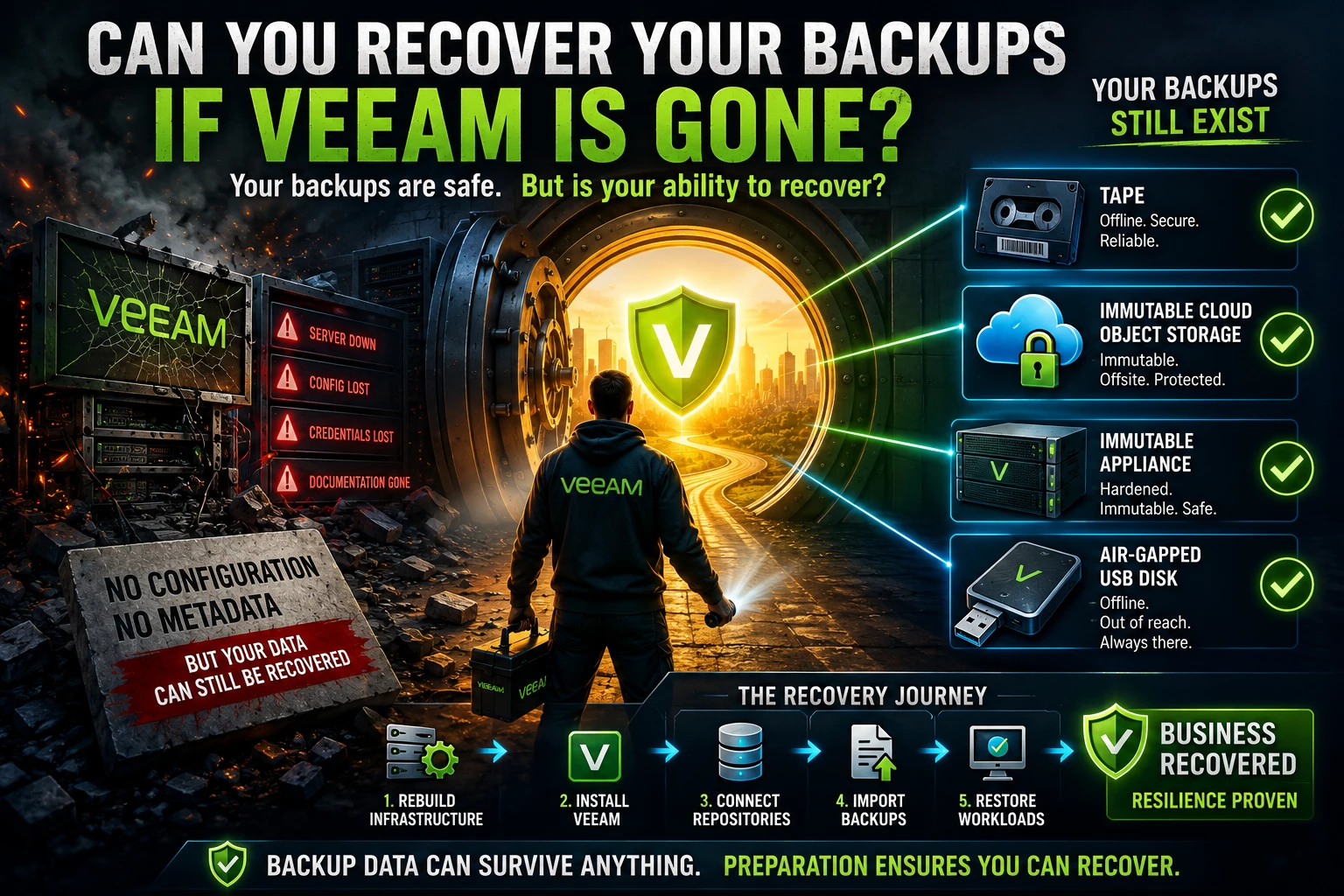
Most organizations spend significant time and effort protecting their backup data.
They implement:
- Immutable repositories
- Air-gapped storage
- Tape archives
- Object storage with Object Lock
- The 3-2-1-1-0 or 3-2-1-2-0 rule
As a result, they feel confident that their data is safe.
But let me ask a different question:
What if your Veeam Backup & Replication server no longer exists?
What if ransomware, a hardware failure, human error, or even a disaster destroys:
- The Veeam Backup Server
- The configuration database
- Enterprise Manager
- Credentials
- Documentation
- Recovery runbooks
And all that remains are your protected backup copies?
Could you still recover your business?
If you cannot confidently answer "yes", then you may have discovered the biggest gap in your disaster recovery strategy.
Backup Data vs. Recovery Capability
Many organizations focus on protecting backup files.
That is important.
However, cyber resilience is not measured by the existence of backup files.
It is measured by the ability to restore services and resume business operations.
There is a significant difference between the fact that backup data exists and recovery capability exists.
Having backup files available is not sufficient, recovery procedures need also be available.
Also credentials and documentation needs to be available.
In that way recovery can actually start when data is survived.
Backup data surviving a disaster does not automatically mean recovery is possible.
The Worst-Case Scenario
Imagine the following situation.
A ransomware attack compromises your environment.
The attackers successfully destroy:
❌ Veeam Backup Server
❌ Configuration Database
❌ Enterprise Manager
❌ Stored Credentials
❌ Documentation
Yet your protected copies survive because they were:
- Air-gapped
- Immutable
- Offline
- Offsite
This sounds like a success story.
But the next question becomes:
How do you recover if all operational knowledge has disappeared?
Scenario 1: Only Tape Backups Remain
Tape remains one of the most effective forms of air-gapped protection.
Even if attackers compromise your environment, they cannot encrypt tapes stored offline.
Recovery Process
- Build new infrastructure
- Install Veeam Backup & Replication
- Connect the tape library
- Perform tape inventory
- Import and catalog backup sets
- Identify restore points
- Begin workload recovery
Challenges
- Long cataloging times
- Missing documentation
- Lost encryption keys
- Unclear recovery priorities
Tape can save your business.
But only if you know how to use it during a crisis.
Scenario 2: Only Immutable Cloud Object Storage Remains
Many organizations use immutable cloud repositories such as:
- Amazon S3 Object Lock
- Azure Blob Immutable Storage
- Wasabi Object Lock
- S3-Compatible Object Storage
The backup files survive.
The metadata and configuration may not.
Recovery Process
- Deploy a new Veeam server
- Re-establish cloud connectivity
- Reconnect repositories
- Rescan backup data
- Import backup chains
- Rebuild the restore inventory
Challenges
- Access credentials
- Network configuration
- Encryption keys
- Repository identification
The backups are protected.
The recovery knowledge must be protected too.
Scenario 3: Only an Immutable Appliance Remains
Hardened repositories and immutable backup appliances provide excellent ransomware protection.
However, if the Veeam infrastructure is lost, administrators must still:
- Rebuild the Veeam environment
- Reconnect repositories
- Rescan backup chains
- Reconstruct recovery workflows
Many organizations discover they have documented how to create backups but not how to recover the backup platform itself.
Scenario 4: Only an Air-Gapped USB Disk Remains
The simplest air-gap strategy may also be the most effective.
An offline disk cannot be encrypted while disconnected.
However, recovery now depends on questions such as:
- Who knows where the disk is stored?
- Who has the encryption password?
- Who knows the recovery procedure?
- Who knows which backup chain is the latest?
The technology may survive.
The process may not.
The Missing Component: Documentation
In many environments, documentation receives far less attention than infrastructure.
That is a mistake.
I would argue that during a disaster, documentation can be just as important as the backups themselves.
Therefore I strongly recommended to perform at least once such a disaster recovery scenario. I do this regularly for my customers.
Imagine the only thing you have is a tape, perform all steps needed to recover your business and document in detail all steps in a recovery plan.
A lot of stress and time will be eliminated when such disaster actually woud occur!
Critical Information to Protect
- Repository locations
- Object storage details
- Tape handling procedures
- Encryption passwords
- Service account information
- Recovery sequences
- Emergency contacts - stakeholders
- Recovery runbooks - disaster recovery test procedures - disaster recovery plans
Store This Information
✔ Securely
✔ Offline
✔ Independently from Veeam
✔ Regularly updated
Because documentation that is unavailable during a disaster is effectively no documentation at all.
The Recovery Test Nobody Performs
Most organizations regularly test:
✔ File-Level Restores
✔ VM Restores
✔ Instant Recovery
✔ SureBackup Verification
These tests are valuable.
However, very few organizations test:
❌ Complete Veeam Server Loss
❌ Configuration Database Loss
❌ Recovery Using Only Tape
❌ Recovery Using Only Immutable Object Storage
❌ Recovery Using Only Air-Gapped Copies
Ironically, these are exactly the scenarios that cyber resilience is designed to address.
Questions Every Organization Should Be Able to Answer
Ask yourself:
- Could we rebuild Veeam from scratch?
- Could we reconnect our repositories?
- Do we know where our encryption keys are stored?
- Could another administrator perform the recovery?
- Is our recovery documentation available offline?
- Have we ever tested a complete backup platform recovery?
If any answer is "No" or "I'm not sure", then you have identified an opportunity to strengthen your resilience strategy.
Cyber Resilience Is More Than Backup Protection
Immutable backups are critical.
Air-gapped storage is critical.
Offsite copies are critical.
But cyber resilience goes beyond protecting data.
It also means protecting the ability to recover.
Backup data can survive anything.
Preparation ensures you can recover.
Conclusion
Many organizations ask:
"Are my backups protected?"
A better question is:
"Can I recover my business if all I have left are my protected backup copies?"
Because the ultimate test of cyber resilience is not restoring a virtual machine.
It is rebuilding your recovery capability when everything else is gone.
And that is a scenario every organization should test before disaster strikes.