


In recent months, Veeam has been making a series of changes to its certifications. We have changes in the certification model and in the format of the courses and teaching methods. I'll discuss the main changes and alterations on this topic here.
Retired Certifications
The Veeam certification path has always consisted of two levels of knowledge. These are:
VMCE (Veeam Certified Engineer) – a technical level focused on operations
VMCA (Veeam Certified Architect) – an advanced level focused on architecture design and project implementation
From the beginning, this model was very well received by the market and widely adopted. Its success is largely due to the absence of an entry-level (foundation) certification. As a result, the certification exams have always been considered highly challenging; however, the knowledge gained has consistently delivered significant value, enabling rapid career growth and professional development.
However, with continuous technological advancements and the evolution of the security landscape, Veeam is restructuring this certification model.
Retirement of VMCA
The first major change was the retirement of the VMCA certification, which officially expired on November 30, 2025.
Retirement of VMCE
Another significant change is the retirement of the VMCE certification. Initially, it was announced to expire on December 31, 2025. However, Veeam extended this deadline to March 31, 2026.
New Certifications
With these changes, new certifications have been introduced, along with an updated training and learning methodology.
VMCE+ | Veeam Certified Engineer
One of the key updates is the introduction of the VMCE+ certification. It remains the entry-level certification within the Veeam track; however, similar to the former VMCE, it represents an intermediate level of expertise in Veeam solutions due to its expanded technical scope.
While the previous VMCE primarily focused on Veeam Backup & Replication, the VMCE+ now requires knowledge across three core platform products:
- Veeam Backup & Replication (backup and replication)
- Veeam ONE (monitoring, reporting, and analytics)
- Veeam Recovery Orchestrator (automation and disaster recovery)
Additionally, Veeam continues to require mandatory training courses totaling over 50 hours, along with a deeper level of platform proficiency.
As a result, the VMCE+ is no longer purely operational—it now validates competencies in management, analytics, and automation, reflecting real-world enterprise environments.
VMCSE | Veeam Certified Security Expert
This represents Veeam’s main strategic shift. The VMCSE certification moves away from the traditional focus on operations (VMCE) and architecture (VMCA), toward a strong emphasis on security and ransomware protection.
New Certification Path
The updated certification path is structured as follows:
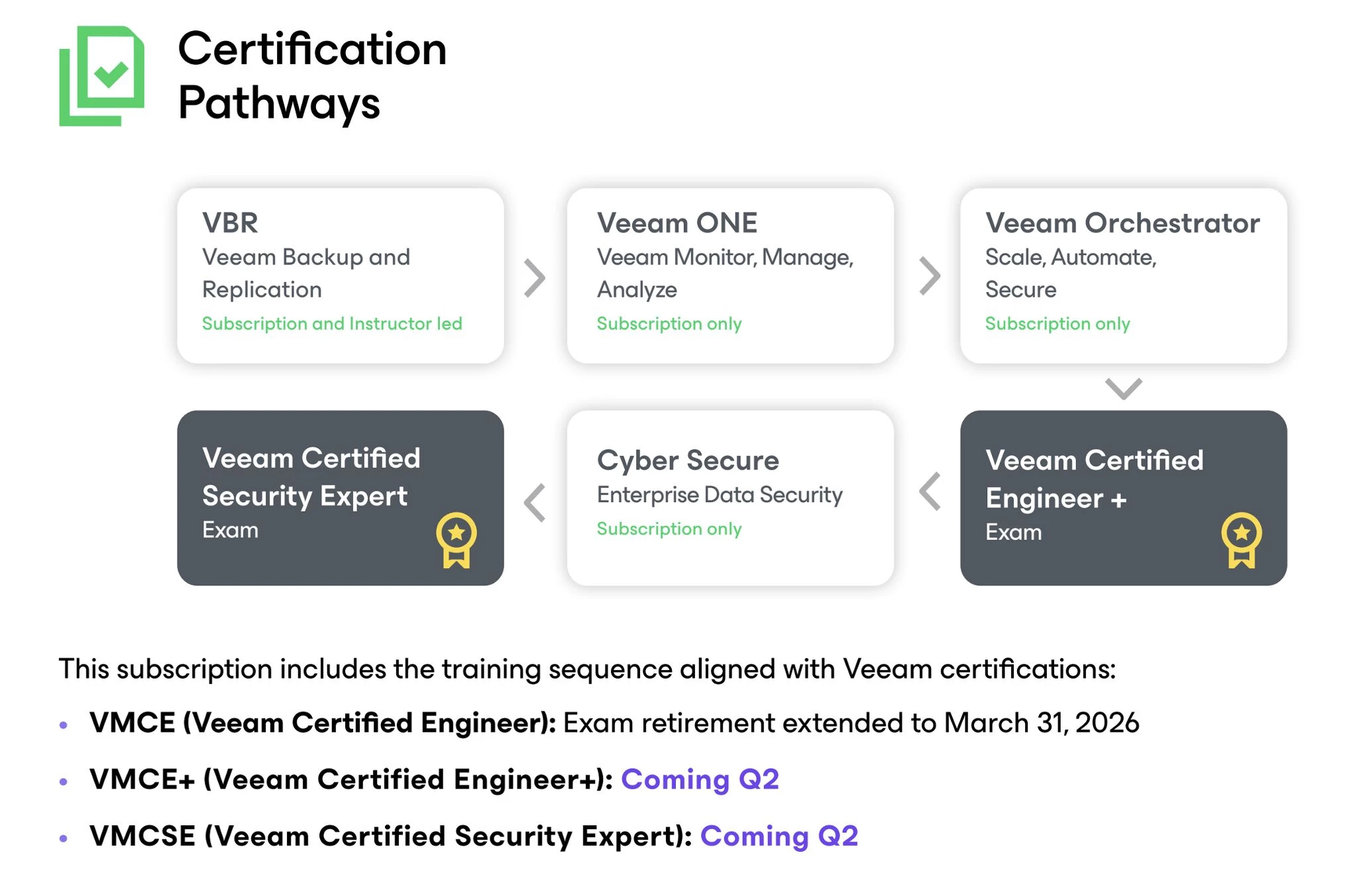
VMCE+ Requirements
- Complete Veeam Backup & Replication: Configuration, Management, and Recovery Training
- Complete Veeam Data Platform: Monitor, Manage and Analyze (Veeam ONE)
- Complete Veeam Data Platform: Scale, Automate and Protect (Veeam Orchestrator)
- Pass the Exam
VMCSE Requirements
- Hold a valid VMCE+ certification
- Complete Veeam Data Platform: Enterprise Data Security (Cyber Secure) training
- Pass the Exam
Veeam University
Veeam currently offers a comprehensive set of courses through its e-learning platform, Veeam University. This is Veeam’s official training and certification program, designed to enable IT professionals to effectively use the Veeam Data Platform.
To pursue the VMCE+ and VMCSE certifications, a subscription to Veeam University Pro is required. This subscription provides access to official training content, which was previously only available through authorized training centers.
Conclusion
These changes go beyond simple updates to technical certifications. This evolution directly reflects current market demands, where backup alone is no longer sufficient. Instead, it has become part of a broader cyber resilience strategy, focused on protecting organizations against cyberattacks and critical failures that can severely impact business continuity.