


Veeam Oxford Style Debate #4

Veeam Oxford Style Debate – Episode 4 -Who Should Detect Malware?

  • Oct 5, 2026 10:07 AM UTC
  • 32 comments
  • 458 views
Show first post

32 comments

Scott
Forum|alt.badge.img+10
  • Veeam Legend
  • Nov 18, 2026 5:51 PM UTC

AGAINST. 

I have had Veeam Malware detection discover dormant files (last access around 2008) in backups where the files had their name changed, were encrypted, and marked as hidden / system.


Files like this won’t show, but when someone does a RoboCopy on a file share during a migration or mounts a disk to a server, Veeam detects malware. Technically it’s correct. No other tools seemed to notice when this issue was happening.  Defender didn’t care either, even with full scans etc.


I am not a fan of alert fatigue, or getting my email spammed, however, being able to have a backup admin notify security, who may have missed something is an amazing feature. This also will allow us to find the last clean backup in our environment if we ever need to restore. 


Iams3le
Forum|alt.badge.img+15
  • Nov 23, 2026 2:57 PM UTC

Many customers are telling me that they disabled it to not cause issues. Another reason is that they don’t trust that “tool” at all and have a “mature” EDV / AV / FW solution. Although I get the point, why not have that additional layer of security, even if that means only catching 5-10%? Why not take this with them and use it in addition to what’s already there (“mature tools”)?

Cheers!

Lukas

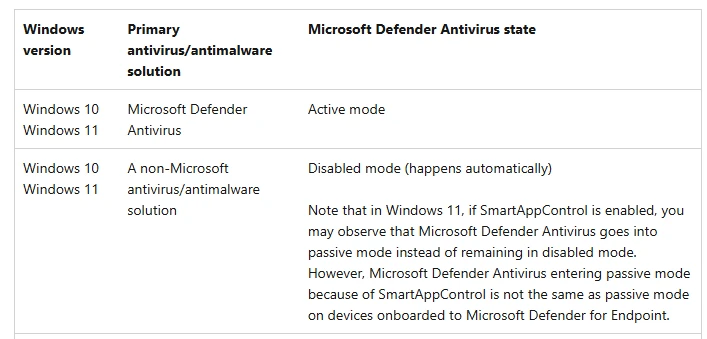
Thanks Lukas for your vital point. Before adding my points, I was reading through the comments so I do not repeat what someone has said. I know this is from a customer and should in case someone else has this disabled. I personally do not recommend disabling Microsoft Defender entirely. Having a mature 3rd endpoint protection solution doesn't automatically mean that the built-in Windows security capabilities should be completely disabled. Microsoft Defender can coexist with third-party security solutions in a passive mode. This allows organisations to benefit from additional Microsoft Defender for Endpoint capabilities which can help detect and remediate threats that might have bypassed the primary antivirus solution.


Ref(s):


For the table discussing Windows Server, I will recommend checking the links referenced above.


Iams3le
Forum|alt.badge.img+15
  • Nov 23, 2026 7:19 PM UTC

Bringing the argument forward once again

  • Using Veeam for malware detection (Inline Entropy and YARA scanning) is a distraction from dedicated EDR tools.
  • Another big aspect missed by some of us "Who Should Detect Malware?". Thankfully, ​@Viperian addressed this due to unclear ownership and ..., ​@Dynamic addressed this in his comment where he emphaized it could become a distraction if nobody owns the alerts, and and ​@matheusgiovanini argued who "investigates the alerts? … who approves the recovery point? Without a defined workflow, concerns about alert fatigue and operational overhead are valid."

Drawing on these points, organizations must establish clear ownership and accountability for how malware alerts are triaged and acted upon. As ​@kciolek, rightly noted, a backup engineer’s responsibility goes beyond simply ensuring green backup jobs,  and that they must help ensure organizations can recover safely after an attack. 

Defining this workflow and assigning clear ownership can help prevent friction between IT and security teams.


Against: 
 

I disagree that using Veeam for malware detection is a distraction from dedicated EDR solutions.

It is important to note that Veeam’s strategic vision has evolved from simple backup and recovery into comprehensive Data Resilience and proactive cyber defense. By integrating capabilities such as Inline Entropy Analysis, Threat Center/Recon, YARA scanning and Veeam Threat Hunter into its data protection platform, Veeam extends threat detection and security visibility into the backup environment, turning backup from a passive recovery mechanism into an additional layer of threat detection and recovery assurance.

At this stage, we will have to distinguish between detecting threats in production and identifying potentially compromised data within backup repositories. EDR and Veeam's Inline Entropy Analysis and YARA scanning provide different layers of visibility. 

To add to the point above as discussed here “Data protection has evolved significantly in recent years. Discussions have shifted from inline vs. post-process deduplication to security focused topics such as workload immutability, incident response, and malware detection. Backups scanning for malware was and never is meant to replace traditional endpoint or extended detection and response tools. It is meant to provide an additional layer of detection for a defense-in-depth approach for detecting malware.”

Therefore, my position is that Veeam for malware detection is  not a distraction from dedicated EDR solutions. I do not see these technologies as competing solutions. I see them as complementary solution that should work together.

Therefore, having overlapping security solutions is not necessarily a distraction. Poorly defined responsibilities and a misunderstanding of what each technology actually delivers are the real problems.
 

Who Should Detect Malware?
Ultimately, I believe this comes down to proper security architecture, governance and segregation of duties. Larger organisations may have dedicated teams responsible for EDR, infrastructure security, backup and incident response. Smaller organisations may not have that luxury, meaning responsibilities often overlap and everyone must contribute to the overall security posture. Also, the usecase raised by ​@tm67 for MSP fits into this explaination correctly.

In an organisation with clearly defined responsibilities, malware detection may primarily sit with a dedicated security team or SOC, while infrastructure or backup teams ensure flawless backup and recovery. However, not every organisation has this level of separation. In some environments, system administrators, infrastructure engineers and security teams share responsibilities for maintaining and protecting the IT environment. We all have been involved in similar roles (firefighting) and in this case, everyone needs to contribute to the organisation's overall security posture.


To answer the questions from Edwin below: 

> If your CIO or procurement team asks, “Why are we paying twice for malware detection?”, how do you explain the distinction in one sentence?

EDR focuses on detecting and responding to threats in the live environment, while Veeam provides additional visibility into backup data and helps establish whether recovery points are safe to restore.

For example, if we were attacked, do we have clean data to recover from? An organization that chooses one over the other has misunderstood both technologies. The real value comes from using them together, not treating them as competing products.

I will further share this link with them to read 😄: https://www.veeam.com/blog/veeam-s-comprehensive-malware-detection-before-during-and-after-a-backup.html

> Would you ever accept reduced EDR coverage because Veeam Threat Hunter, YARA scanning and inline entropy analysis are enabled?

Absolutely not. I would not consider Veeam a replacement for EDR, nor would I recommend reducing EDR coverage because backup scanning is enabled. They serve different purposes. In fact, having multiple layers of detection is precisely what defence in depth is about.

We should not create a security gap simply because another product offers some overlapping functionality. What if the EDR misses a malware in production (live environemnt) and then make it into the backup chain undetected, the organization can end up “recovering” straight back into an infected state?

> If the answer is no, are we doing enough to position Veeam as recovery assurance rather than as an alternative security detection platform?

I think this is where organisations need to improve their understanding of Veeam's broader strategic direction. Its evolution from traditional backup and recovery towards comprehensive data resilience and proactive cyber defence demonstrates that its role is no longer limited to backup and recovery alone thereby, complementing security capability that strengthens an organisation's overall defence-in-depth strategy, without replacing dedicated EDR solutions.

By integrating capabilities such as Inline Entropy Analysis, Veeam Threat Hunter, YARA scanning and Threat Center, Veeam extends threat detection and security intelligence into the backup environment. In effect, it turns backup from a passive  backup and recovery mechanism into an additional layer of security visibility and threat detection.

We should do more to communicate how its integrated threat detection capabilities contribute to recovery assurance, helping organisations identify potentially compromised backups and make more informed recovery decisions.


lucasmagnum
Forum|alt.badge.img+3
  • Experienced User
  • Nov 23, 2026 7:47 PM UTC

Bringing the argument forward once again

  • Using Veeam for malware detection (Inline Entropy and YARA scanning) is a distraction from dedicated EDR tools.
  • Another big aspect missed by some of us "Who Should Detect Malware?". Thankfully, ​@Viperian addressed this due to unclear ownership and poor purchasing decisions, ​@Dynamic addressed this in his comment where he emphaized it could become a distraction if nobody owns the alerts, and and ​@matheusgiovanini argued who "investigates the alerts? … who approves the recovery point? Without a defined workflow, concerns about alert fatigue and operational overhead are valid."

Drawing on these points, organizations must establish clear ownership and accountability for how malware alerts are triaged and acted upon. As ​@kciolek, rightly noted, a backup engineer’s responsibility goes beyond simply ensuring green backup jobs,  and that they must help ensure organizations can recover safely after an attack. Defining this workflow and assigning clear ownership can help prevent friction between IT and security teams.


Against: 
 

I disagree that using Veeam for malware detection is a distraction from dedicated EDR solutions.

It is important to note that Veeam’s strategic vision has evolved from simple backup and recovery into comprehensive Data Resilience and proactive cyber defense. By integrating capabilities such as Inline Entropy Analysis, Threat Center/Recon, YARA scanning and Veeam Threat Hunter into its data protection platform, Veeam extends threat detection and security visibility into the backup environment, turning backup from a passive recovery mechanism into an additional layer of threat detection and recovery assurance.

At this stage, we will have to distinguish between detecting threats in production and identifying potentially compromised data within backup repositories. EDR and Veeam's Inline Entropy Analysis and YARA scanning provide different layers of visibility. 

To add to the point above as discussed here “Data protection has evolved significantly in recent years. Discussions have shifted from inline vs. post-process deduplication to security focused topics such as workload immutability, incident response, and malware detection. Backups scanning for malware was and never is meant to replace traditional endpoint or extended detection and response tools. It is meant to provide an additional layer of detection for a defense-in-depth approach for detecting malware.”

Therefore, my position is that Veeam for malware detection is  not a distraction from dedicated EDR solutions. I do not see these technologies as competing solutions. I see them as complementary capabilities that should work together.

Therefore, having overlapping security capabilities is not necessarily a distraction. Poorly defined responsibilities and a misunderstanding of what each technology actually delivers are the real problems.
 

Who Should Detect Malware?
Ultimately, I believe this comes down to proper security architecture, governance and segregation of duties. Larger organisations may have dedicated teams responsible for EDR, infrastructure security, backup and incident response. Smaller organisations may not have that luxury, meaning responsibilities often overlap and everyone must contribute to the overall security posture. Also, the usecase raised by ​@tm67 for MSP fits into this explaination correctly.

In an organisation with clearly defined responsibilities, malware detection may primarily sit with a dedicated security team or SOC, while infrastructure or backup teams ensure flawless backup and recovery. However, not every organisation has this level of separation. In some environments, system administrators, infrastructure engineers and security teams share responsibilities for maintaining and protecting the IT environment. We all have been involved in similar roles (firefighting) and in this case, everyone needs to contribute to the organisation's overall security posture.


To answer the questions from Edwin below: 

> If your CIO or procurement team asks, “Why are we paying twice for malware detection?”, how do you explain the distinction in one sentence?

EDR focuses on detecting and responding to threats in the live environment, while Veeam provides additional visibility into backup data and helps establish whether recovery points are safe to restore.

I will further share this link with them to read 😄: https://www.veeam.com/blog/veeam-s-comprehensive-malware-detection-before-during-and-after-a-backup.html

> Would you ever accept reduced EDR coverage because Veeam Threat Hunter, YARA scanning and inline entropy analysis are enabled?

Absolutely not. I would not consider Veeam a replacement for EDR, nor would I recommend reducing EDR coverage because backup scanning is enabled. They serve different purposes. In fact, having multiple layers of detection is precisely what defence in depth is about.

We should not create a security gap simply because another product offers some overlapping functionality. What if the EDR misses a malware in production (live environemnt) and then make it into the backup chain undetected, the organization can end up “recovering” straight back into an infected state?

> If the answer is no, are we doing enough to position Veeam as recovery assurance rather than as an alternative security detection platform?

I think this is where organisations need to improve their understanding of Veeam's broader strategic direction. Its evolution from traditional backup and recovery towards comprehensive data resilience and proactive cyber defence demonstrates that its role is no longer limited to backup and recovery alone thereby, complementing security capability that strengthens an organisation's overall defence-in-depth strategy, without replacing dedicated EDR solutions.

By integrating capabilities such as Inline Entropy Analysis, Veeam Threat Hunter, YARA scanning and Threat Center, Veeam extends threat detection and security intelligence into the backup environment. In effect, it turns backup from a passive  backup and recovery mechanism into an additional layer of security visibility and threat detection.

We should do more to communicate how its integrated threat detection capabilities contribute to recovery assurance, helping organisations identify potentially compromised backups and make more informed recovery decisions.


Very good ​@Iams3le !!! 

matheusgiovanini
Forum|alt.badge.img+12

Bringing the argument forward once again

  • Using Veeam for malware detection (Inline Entropy and YARA scanning) is a distraction from dedicated EDR tools.
  • Another big aspect missed by some of us "Who Should Detect Malware?". Thankfully, ​@Viperian addressed this due to unclear ownership and poor purchasing decisions, ​@Dynamic addressed this in his comment where he emphaized it could become a distraction if nobody owns the alerts, and and ​@matheusgiovanini argued who "investigates the alerts? … who approves the recovery point? Without a defined workflow, concerns about alert fatigue and operational overhead are valid."


Thanks C, I appreciate you bringing my point into the discussion.

I think this is where the distinction between detecting a threat and making a recovery decision becomes particularly important. Detection is only one part of the process. During an incident, someone still needs to investigate the findings, correlate them with other available information, assess the risk and determine which recovery point can be trusted.

That is why I see Veeam's malware detection capabilities as valuable beyond simply identifying suspicious files. They can contribute to the decision-making process and help reduce uncertainty when recovery is required.

Ultimately, technology alone does not define an effective security strategy. The processes, responsibilities and decisions behind it are just as important.


Iams3le
Forum|alt.badge.img+15
  • Nov 27, 2026 2:06 PM UTC

I am challenging these great folks: ​@coolsport00, ​@JMeixner , ​@Link State, and ​@Michael Melter. 


JMeixner
Forum|alt.badge.img+18
  • On the path to Greatness
  • Nov 28, 2026 11:13 AM UTC

FOR – Malware detection is a security discipline, not a backup discipline

I deliberately take the FOR position in this debate, although I certainly do not advocate disabling malware detection within Veeam. Quite the opposite. I consider malware detection in the backup environment an important element of a comprehensive cyber resilience strategy.

However, we must distinguish between extending the capabilities of a backup solution and establishing a professional cybersecurity architecture.

Coming from more than 30 years in IT, with a strong focus on enterprise data protection and backup architectures, I believe that the principle of clearly defined responsibilities remains essential. A backup solution must primarily ensure the availability, integrity and recoverability of data. A dedicated security solution must take responsibility for threat detection, investigation, prevention and response.

These responsibilities should complement each other rather than compete.

In most cases, I work with larger clients and am employed by a major service provider. Consequently, I generally have the resources available to separate responsibilities. My line of reasoning presented here is based on this context.
For smaller companies or clients, the situation may be different.


Inline Entropy Analysis – a valuable indicator, but not a security verdict

Veeam's Inline Entropy Analysis is an interesting capability. Analysing data blocks during backup operations provides an additional opportunity to identify suspicious changes in protected workloads. Increased levels of encryption, ransomware notes and certain other artifacts can indicate malicious activity.

However, high entropy is a characteristic of data, not proof of malicious activity.

Legitimately encrypted files, compressed archives, software packages and other data structures can produce similar patterns. In large enterprise environments, distinguishing legitimate changes from malicious activity can become a considerable operational challenge.

Furthermore, Inline Entropy Analysis is tied to the backup process. If a workload is protected once every 24 hours, a considerable amount of time may pass before suspicious activity becomes visible to Veeam. A dedicated EDR solution, on the other hand, can observe suspicious process behaviour while it is happening and potentially intervene before significant damage occurs.

There is also an operational cost. According to Veeam's documentation for version 13, inline scanning may increase backup proxy CPU utilisation by an average of 10–15%, depending on the workload and data volume. In an enterprise environment protecting several thousand workloads, this is something that needs to be considered when sizing the infrastructure and designing backup windows.

For me, Inline Entropy Analysis is an additional security sensor. It is not a replacement for behavioural analysis, endpoint telemetry or a professional ransomware prevention mechanism.

File System Activity Analysis – additional visibility, with limitations

Veeam also provides malware detection based on file system indexing data. Suspicious filenames, extensions, indicators of compromise, unusual file deletions and extension changes can provide additional evidence of malicious activity.

This is particularly valuable when endpoint protection has been compromised, disabled or was never deployed.

Nevertheless, these mechanisms observe artifacts and changes. They generally cannot provide the process context necessary to establish which user, executable, script or network connection caused the activity.

An attacker using legitimate administrative tools, compromised credentials or fileless attack techniques may leave little evidence that these backup-oriented detection mechanisms can identify.

Again, the information is valuable, but interpreting it requires additional security intelligence.

YARA scanning – powerful, but dependent on security expertise

YARA scanning is probably one of the most valuable malware detection capabilities within Veeam, particularly from a cyber recovery and forensic investigation perspective.

The ability to retrospectively scan historical restore points using newly developed YARA rules opens possibilities that real-time endpoint monitoring alone cannot necessarily provide.

Consider a scenario in which a security operations centre discovers a previously unknown malware component. The security team develops or obtains an appropriate YARA rule and uses Veeam to search historical backups for related artifacts.

This can help determine how far back evidence of a compromise exists and narrow down the selection of suitable recovery points.

However, the effectiveness of YARA depends heavily on the quality, relevance and maintenance of the rules being used.

Who develops these rules? Who validates them? Who maintains them as threats evolve? Who investigates false positives and determines whether a match represents a genuine security incident?

These are not traditional backup administration responsibilities. They require threat intelligence, malware analysis and cybersecurity expertise.

I would therefore expect the SOC or a dedicated security platform to provide validated detection rules, while Veeam provides the mechanisms to execute them against historical backup data.

Veeam Threat Hunter, third-party antivirus integration and Secure Restore

The discussion should not be limited to Inline Entropy Analysis and YARA.

Veeam Backup & Replication also provides several complementary capabilities:

  • Veeam Threat Hunter for signature-based malware detection.
  • Integration of supported third-party antivirus scanning engines.
  • Scan Backup for investigating historical restore points.
  • Secure Restore for malware scanning as part of the recovery process.
  • Malware scanning within SureBackup recovery verification workflows.
  • Proactive signature-based scanning.
  • Integration with external security solutions through the Veeam Incident API.

The combination of these capabilities allows organisations to establish multiple malware detection and recovery validation mechanisms within their data protection architecture.

In particular, the possibility of using a supported third-party malware scanning engine alongside YARA rules is an important architectural consideration.

Rather than independently building and maintaining a complete malware detection strategy within the backup environment, I would integrate a professionally managed security solution into the recovery workflow.

Veeam provides the access to historical data and the operational recovery mechanisms. Dedicated security technologies provide additional detection intelligence and investigation capabilities.

The Veeam Incident API – the direction we should be taking

From my perspective, the Veeam Incident API is one of the most strategically important capabilities in this context.

It allows external malware protection solutions to communicate detected security incidents to Veeam. Affected workloads can be identified as infected, and, depending on the configuration, an additional backup can be triggered.

This creates an opportunity to establish a coordinated workflow between cybersecurity and data protection.

Imagine the following enterprise ransomware scenario:

  1. The EDR platform identifies malicious activity on a production server.
  2. The security platform initiates containment measures and informs the SOC.
  3. The incident is communicated to Veeam through the Incident API.
  4. Existing backup data is protected and relevant restore points are investigated.
  5. The security team provides updated indicators of compromise and YARA rules.
  6. Veeam scans historical restore points using the supplied rules and an appropriate malware scanning engine.
  7. Potential recovery candidates are restored into an isolated recovery environment.
  8. The security team performs further forensic analysis and validates the systems.
  9. Production recovery is authorised only after the remaining security risks have been assessed.

In this scenario, neither Veeam nor EDR operates in isolation.

An additional incident-triggered backup could also preserve valuable evidence, provided this is coordinated with the incident response team. Such a backup must obviously not be mistaken for a validated recovery point.

More detection mechanisms do not automatically mean more security

Several contributors to this debate argue that an additional layer of malware detection cannot hurt.

I would challenge that argument.

Every additional detection mechanism introduces operational responsibilities, infrastructure requirements, alert management and potential false positives.

In a large, multi-tenant managed backup environment, enabling malware detection across thousands of workloads without integrating the resulting events into established security processes could create a substantial operational burden.

A malware alert that nobody investigates does not improve security.

A YARA rule that nobody maintains does not provide sustainable protection.

A restore point marked as clean without understanding the limitations of the underlying detection methods can create a dangerous sense of confidence.

Defence in depth is not simply about increasing the number of detection tools. It is about combining complementary capabilities into a coordinated architecture with clearly defined responsibilities.

I would expect Veeam malware detection events to be integrated into a central SIEM, XDR or SOAR environment, where available telemetry can be correlated with endpoint events, identity-related incidents, network activity and threat intelligence.

The backup administrator should not have to become a malware analyst, just as a security analyst should not have to become a backup infrastructure specialist.

A successful malware scan does not guarantee a clean restore point

This is another important distinction.

A restore point that has been scanned without detecting malware is not necessarily uncompromised. It simply means that the applied detection mechanisms did not identify malicious artifacts within the scope of that particular scan.

The initial compromise may have involved stolen credentials, malicious configuration changes, compromised identities or persistence mechanisms that are not recognised by the selected scanning engine.

Even a technically successful SureBackup job combined with malware scanning should not automatically be interpreted as security clearance for production recovery.

Identifying a trustworthy recovery point requires the combination of backup validation, threat intelligence, forensic investigation and security assessment.

My conclusion

I vote FOR the motion because I believe that malware detection within Veeam becomes a distraction when it is treated as an independent cybersecurity capability instead of being integrated into a professional security architecture.

I fully support using Inline Entropy Analysis, File System Activity Analysis, YARA scanning, Veeam Threat Hunter, third-party antivirus integration and Secure Restore wherever they provide meaningful additional value.

However, dedicated EDR and XDR solutions, supported by centralised security monitoring and professional incident response processes, must remain at the centre of the organisation's malware detection and response strategy.

Veeam should extend the visibility of these security solutions into the backup and recovery domain, not compete with them.

The objective should not be to make every backup administrator a security analyst or every backup product an EDR platform.

The objective should be to establish an integrated cyber resilience architecture in which every component contributes its specific strengths.

Let EDR protect the production environment. Let Veeam protect recoverability. Let both share their security intelligence to increase protection against malware.

That is defence in depth done properly.

My vote: FOR.