

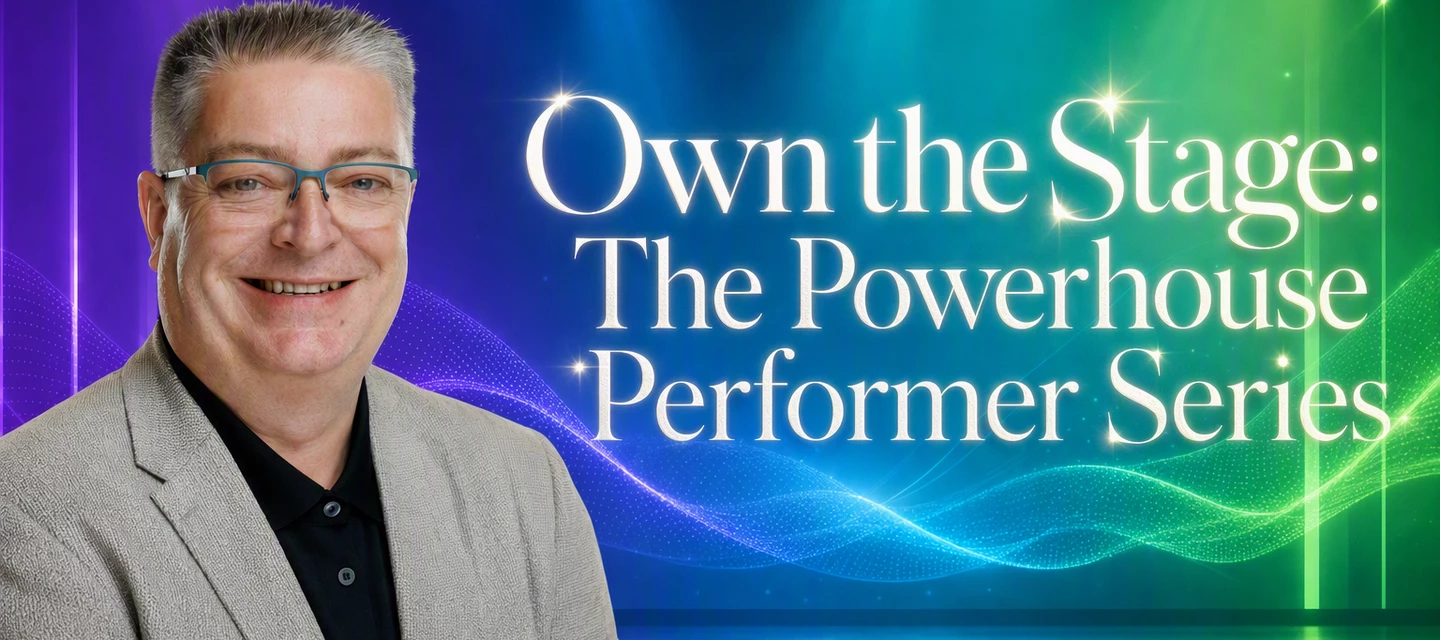


Finding your authentic stage voice is one of the most important steps in becoming a powerful performer.
Because at some point, you need to stop trying to sound like a presenter. You need to start sounding like you.
That may sound simple, but it is not always easy. Especially in the beginning. When you start presenting, you naturally look at others. You watch people you admire. You study how they move, how they tell stories, how they use humor, how they open, how they control the room, and how they make difficult topics feel easy.
That is good.
You should learn from others. But you should not become a copy of them. Because the audience can feel it when you are trying to play someone else.
And they can definitely feel it when you are truly yourself.
My voice started with curiosity
For me, my authentic stage voice is built around curiosity.
I like to explore.
I like to explore technology.
I like to explore human behavior.
I like to explore the room.
I like to explore the people in the audience.
I like to see opportunities everywhere.
That is very much who I am. I have been an explorer for more than thirty years, whether it is around infrastructure, new technology, storytelling, or how people respond to a message.
I am an ENFP type, and that fits me well. I get energy from people, ideas, stories, and possibilities.
On stage, that became one of my strengths.
I do not just want to explain something. I want to explore it with the audience. I want to take them with me. I want to look at a topic from different angles. I want to connect the technical side with the human side.
That is where my voice started to become more authentic.
Sharp on topic, but with a lemon twist of humor and perspective.
Humor is part of my style
I like humor on stage.
Not because every presentation needs to become a comedy show, but because humor opens people up. It relaxes the room. It makes people breathe. It helps them listen.
If people laugh, even just a little, they often become more willing to join the journey.
Humor also helps me stay connected to the room. I see opportunities everywhere. If something happens in the room, I may use it. If something unexpected happens, I may turn it into a moment. If the audience gives me a little opening, I might play with it.
But humor needs to fit you. Do not force jokes that are not yours. Do not copy someone else’s humor if it does not match your personality. Do not try to be funny just to be funny.
Humor should support the story. It should make the message land better. It should make the audience feel more connected, not distracted.
For me, humor works because it is part of who I am. It is not a trick I put on top of the presentation. It is part of my voice.
The day Glenn told me to slow down
One of the most important lessons in finding my stage voice came from a technical guy named Glenn.
During one of my earlier performances, I was on stage, fully in the story, probably with too much energy and way too much speed.
Then Glenn put a message on the screen:
“Edwin, great story, but please slow down 50%. You will thank me later.”
I read it. And I slowed down. That moment stayed with me.
It taught me that people need time.
- They need time to register what you say.
- They need time to think.
- They need time to consume the message properly.
As presenters, we often know our story so well that we move too fast. In our own head, everything is clear. We know the context. We know where we are going. We know the punchline. We know the next slide.
But the audience is hearing it in real time. They need space.
So my advice to anyone on stage is simple:
Slow your speed by 50 percent compared to a normal one on one conversation. That may feel strange in the beginning. It may feel too slow. But on stage, it often lands much better.
Speed matters.
Articulation matters.
Tone matters.
Voice matters.
Strength matters.
Silence matters.
Your voice is not just a way to produce words. Your voice is an instrument.
Silence is also part of your voice
One of the biggest improvements in my own delivery came from learning to use silence.
In the beginning, I used too many filler words. Like, like, like.
Yes, even that one.
When you speak too fast, your brain needs time to catch up. That is where filler words often appear. You keep making sound while your mind is looking for the next step.
Slowing down helped me reduce those stop words.
But silence helped even more.
- A pause is not empty.
- A pause can create impact.
- A pause can give people time to think.
- A pause can make a message stronger.
- A pause can create tension before an important point.
- A pause can give you time to breathe and choose your next words.
Many presenters are afraid of silence. They think silence feels awkward. But often, the silence feels much longer to you than it does to the audience.
Used well, silence is one of the most powerful tools you have.
Copy skills, not personalities
In the beginning, I copied other presenters. I think many of us do.
You see someone on stage and think, wow, that works. So you try to copy it.
Their humor.
Their structure.
Their confidence.
Their posture.
Their energy.
Their style.
But I found out pretty quickly that copying someone’s personality does not work.
It becomes fake. It does not feel natural and the audience can sense it.
What does work is learning from techniques. That is different. Do not copy the person. Study the skill.
Look at a presenter and ask yourself:
- Why are they doing that?
- Why did that pause work?
- Why did that opening catch my attention?
- Why did that joke land?
- Why did that movement feel natural?
- Why did the audience trust them?
- Why did that slide work?
- Why did that story make the technical message stronger?
That is how you build your own toolbox.
You observe. You absorb. You test. You keep what fits. You throw away what does not.
That is how your authentic voice grows.
Describe yourself in five words
One tip I often give newcomers is this:
Try to describe yourself in five key words. Not the person you think a presenter should be.
You.
Who are you?
What makes you different?
What kind of energy do you bring?
What do people recognize in you?
For me, my five words are:
Curious, Exploring, Positive, Humor, Pain in the ass
Yes, that last one is intentional.
Because sometimes I ask difficult questions. Sometimes I challenge things. Sometimes I push a little. But if done with the right intention, that can also be useful. It can create better thinking, better conversations, and better outcomes.
Your five words may be completely different.
Calm.
Structured.
Analytical.
Warm.
Direct.
Creative.
Energetic.
Precise.
Personal.
Technical.
There is no right or wrong list.
The goal is to understand what is naturally you, and then build your stage voice around that.
People who influence your journey
Many people influenced my speaking style.
Some influenced me directly.
Some indirectly.
Some by giving feedback.
Some by showing what was possible.
Some by making me think, I want to learn that skill.
Some by showing me what not to do.
That is all part of the journey.
But there is something important about feedback and influence. You need to stay open, but you also need to think for yourself. Not all feedback is equal.
Sometimes feedback is honest and useful.
Sometimes feedback is unclear.
Sometimes feedback hurts because it is true.
Sometimes feedback hurts because it is badly delivered.
And sometimes, unfortunately, not everyone giving feedback wants the best for you.
That is why I always recommend checking feedback with others if you do not fully understand it or if it makes you sad.
Ask someone you trust:
Do you see the same thing?
Is this something I should work on?
Was that fair feedback?
Can you help me understand it?
Feedback can make you better, but you need to process it wisely.
Rick Vanover and seeing what was possible
One person at Veeam who had a lasting impact on my career and experience is Rick Vanover.
He showed me what was possible. At the time, I was a Solution Architect for Benelux and the Nordics, and I looked up to the way Rick represented Veeam. On camera, on stage, with analysts, with media, and as a spokesperson for the company.
He combined technical expertise with storytelling, confidence, community, and visibility in a way that really inspired me.
One moment that stayed with me was during a Veeam President’s Club in 2019, when Rick told my wife that he believed I would go far within Veeam and would do great things. That meant a lot to me.
Sometimes someone else seeing your potential helps you believe in it more yourself.
In 2020, I started the journey to move into the Strategy team. The process took around ten months, largely because of Covid, but that long and unusual journey is probably a great story for another time.
Today, I now do many of those things myself. Speaking on stage, being on camera, working with analysts and media, and acting as a spokesperson for Veeam. That makes his influence even more meaningful. He showed me a path.
And now I hope I can pay that forward by being a role model, supporter, and source of inspiration for others in the same way he was and still is for me.
Practice makes almost perfect
My capabilities have grown in many areas since joining Veeam.
Storytelling. Presenting. Working with analysts and media. Supporting events. Contributing behind the scenes. Helping others succeed. But storytelling is probably the skill that has grown the most.
Over the years, I have had many opportunities to present, explain complex technology, speak with customers and partners, and represent Veeam on stage, on camera, and in different external conversations.
Practice makes almost perfect.
I say almost because I do not believe you are ever truly finished.
There is always something to improve.
A better opening.
A cleaner explanation.
A stronger pause.
A sharper story.
A more natural transition.
A better way to connect with the audience.
Veeam gave me the space to keep practicing, improving, and finding my own voice. That is one of the reasons I believe so strongly in giving others the same opportunity.
What I had to unlearn
Finding your authentic voice is not only about learning. It is also about unlearning. In the beginning, I sometimes became too technical. Too detailed. Too corporate. Then sometimes I went too far the other way and was not serious enough. That is part of the journey too.
You try.
You adjust.
You overcorrect.
You learn.
Eventually you discover that it is all about balance.
There is a time to be technical.
There is a time to be funny.
There is a time to be serious.
There is a time to be personal.
There is a time to speak.
And there is a time to shut up.
That last one is important. Knowing when not to speak is part of being a strong presenter.
Sometimes the audience needs a moment.
Sometimes the message needs silence.
Sometimes someone else in the room needs space.
Sometimes the story is stronger if you do not explain everything.
Authenticity is not just saying whatever comes to mind. Authenticity with professionalism means knowing which part of yourself to bring at the right moment.
How to find your own voice
If you are new on stage and you do not know your style yet, that is normal. You find your voice by doing. In the beginning, it may feel misty and unclear. You may not know what works. You may try something and think, yes, this is me.
You may try something else and think, no, this is definitely not me. That is how you learn.
Experiment.
Record yourself.
Watch yourself back.
Ask for feedback.
Try different formats.
Present to small audiences.
Watch other speakers.
Study techniques.
Check feedback with people you trust.
And be honest with yourself.
Do not ask, “Did I look like that famous presenter?”
Ask, “Did I look like myself?” That is the real question.
Authenticity helps with nerves
Being authentic helps you control your nerves, because you do not have to act. You do not have to stay in character. You do not have to remember how someone else would say it. You can focus on the story, the audience, and the moment.
Trying to play a role makes presenting harder. You are already managing the content, the timing, the audience, the room, the energy, the technology, and your own nerves. If you also need to pretend to be someone else, you add another layer of pressure.
For me, being authentic is easier. It gives me freedom. And people see it. They can sense very quickly if you are real or not.
That does not mean you should walk on stage without preparation or without professionalism. Authenticity is not an excuse to be messy. It means your prepared version still feels like you.
Authentic does not mean unprofessional
This is where balance comes in.
I use humor.
I tell personal stories.
I bring energy.
I like to entertain.
But I also present serious technical content, business topics, and strategic messages.
So how do you balance that? For me, the answer is intention.
Why are you doing it?
If the humor supports the story, use it.
If the personal story helps the message land, use it.
If the energy helps the room engage, use it.
If the entertainment makes the content more memorable, use it.
But if something is only there because you want attention, be careful. There is a difference between serving the audience and serving your ego. A powerful performer entertains to create connection. Not to become the center of the universe.
The topic still matters. The audience still matters. The message still matters. Your authentic voice should amplify the content, not replace it.
The audience wants you
One of the things I believe strongly is that people are interested in the person behind the presentation. Even if you think they are not. Of course, they come for the topic. But they remember the human being who delivered it.
They remember the story.
They remember the moment.
They remember how you made them feel.
They remember if you were real.
That is why finding your authentic stage voice matters so much.
When you are real, people trust you faster.
When you are real, your stories land better.
When you are real, your humor feels natural.
When you are real, your technical content becomes easier to follow.
When you are real, the audience can connect with you.
And connection is where impact begins.
The key lesson
If readers remember only one thing from this part, I would say this:
Do not become a copy of someone else. Learn from everyone, but become more yourself.
Study great presenters, watch their techniques, learn from their timing, rhythm, storytelling, posture, voice, and structure. But do not steal their personality. Build your own.
- Find your five words.
- Practice.
- Slow down.
- Use silence.
- Ask for feedback.
- Watch yourself back.
- Keep what fits.
- Drop what does not.
And then step on stage as the best prepared version of you, because:
Your authentic stage voice is not something you invent. It is something you uncover, practice, sharpen, and finally dare to use.