

Why True Cyber Resilience Requires More Than One Immutable Repository
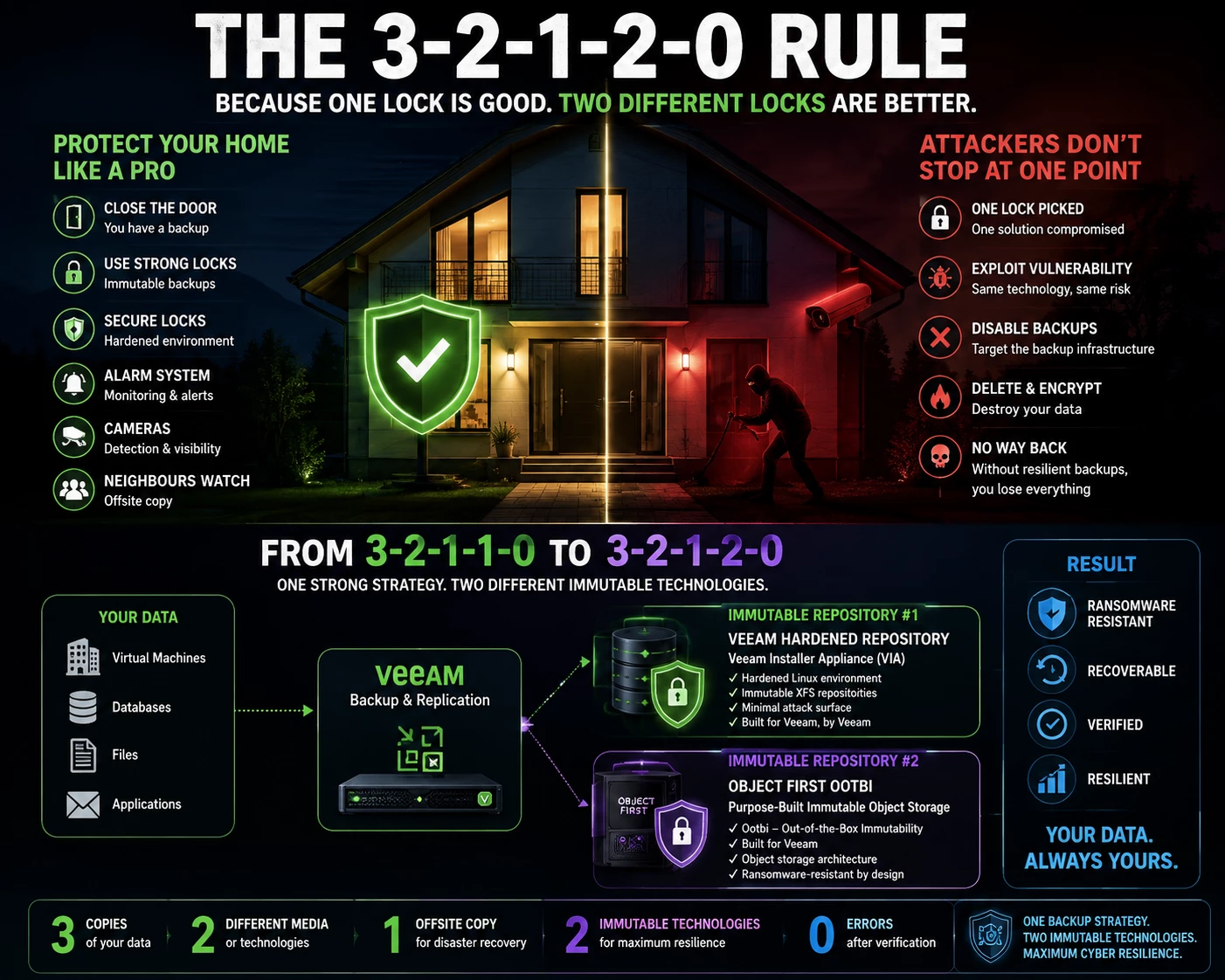
"You wouldn't protect your house with just one lock. So why protect your last line of defense with just one immutable technology?"
For years, the 3-2-1-1-0 rule has been the benchmark for designing resilient backup environments. It has helped thousands of organizations improve their backup strategy and defend themselves against ransomware.
But cyber threats continue to evolve.
Attackers are no longer just encrypting production workloads—they are actively targeting backup infrastructures because they know that if they can destroy your backups, they control your recovery.
That made me think...
Is one immutable repository really enough?
Or should we apply the same security principles that we use everywhere else?
Protecting Your Home
Imagine you're leaving your house for a two-week vacation.
Before you leave, what do you do?
Certainly not just this:
✔ Close the front door.
Instead, you probably do something like this:
-
🔐 Lock the door
-
🔒 Use security locks
-
🚪 Close every window
-
🚨 Activate the alarm system
-
📷 Enable security cameras
-
💡 Turn on automatic lighting
-
👥 Ask the neighbours to keep an eye on your house
Why?
Because security is built in layers.
No single measure guarantees protection.
Every additional layer increases the attacker's effort.
Every additional layer decreases the chance of success.
Now Replace "House" With "Backup Infrastructure"
The same philosophy applies to backup.
Many organizations invest heavily in:
-
Firewalls
-
MFA
-
EDR/XDR
-
Network segmentation
-
Zero Trust
-
Identity protection
Yet when it comes to the last line of defense, they often rely on one immutable repository.
That isn't necessarily wrong.
But it raises an important question.
Why would we rely on a single security technology to protect the most valuable copies of our data?
The Industry Standard: 3-2-1-1-0
Let's briefly revisit the well-known rule.
| Number | Meaning |
|---|---|
| 3 | Keep at least three copies of your data |
| 2 | Store them on two different media or technologies |
| 1 | Keep one copy offsite |
| 1 | Ensure one copy is immutable or offline |
| 0 | Verify zero backup errors through testing |
It remains one of the best backup strategies ever created.
And I still fully support it.
But I believe we can strengthen it even further.
Introducing My 3-2-1-2-0 Rule
The additional 2 is simple.
Use two different immutable technologies.
Not because one isn't secure.
But because technology diversity increases cyber resilience.
Different technologies.
Different architectures.
Different attack surfaces.
Different ways of protecting your data.
Exactly like using both an alarm system and security cameras to protect your house.
Repository #1 – Veeam Hardened Repository
A Veeam Installer Appliance (VIA) running a hardened Linux repository offers:
-
Linux hardening
-
XFS immutability
-
Minimal attack surface
-
Tight Veeam integration
-
Excellent ransomware protection
It has become one of the most trusted repository designs in the Veeam ecosystem.
Repository #2 – Object First OOTBI
Now add an Object First Ootbi appliance.
Purpose-built exclusively for Veeam.
Designed from day one around immutable object storage.
Its strengths include:
-
Out-of-the-Box Immutability
-
Purpose-built architecture
-
Simple deployment
-
Minimal administration
-
Strong ransomware resilience
It doesn't replace the hardened repository.
It complements it.
Why Technology Diversity Matters
Imagine a burglar.
He manages to bypass your security lock.
Your alarm immediately triggers.
Security cameras record everything.
Motion sensors activate.
Neighbours are alerted.
Each layer is independent.
Each layer increases resilience.
The same principle applies to backup repositories.
If one immutable technology experiences an operational issue, misconfiguration, or unforeseen vulnerability, the second repository remains fundamentally different.
That's the power of diversity.
Cyber Resilience Is About Reducing Common Risk
One immutable repository is excellent.
Two immutable repositories based on different technologies are even stronger.
You're not simply creating another copy.
You're reducing shared risk.
You're avoiding putting all your eggs in one security basket.
And that is exactly what resilience is about.
From Backup to Recovery Confidence
At the end of the day, backup is not the goal.
Recovery is.
Your organization doesn't care whether the backup job completed successfully.
It cares whether critical business systems can be restored after a cyberattack.
That's why I believe the conversation should evolve from:
"Do we have immutable backups?"
to
"How resilient is our immutable backup strategy?"
Final Thoughts
The 3-2-1-1-0 rule remains the foundation of modern data protection.
I don't want to replace it.
I want to build upon it.
That's why I advocate what I call the 3-2-1-2-0 rule:
-
✔ 3 copies of your data
-
✔ 2 different storage technologies
-
✔ 1 copy offsite
-
✔ 2 independent immutable technologies
-
✔ 0 backup verification errors
Because cyber resilience isn't about trusting a single lock.
It's about building multiple independent layers that work together to protect what matters most.
What Do You Think?
Would you trust your home to a single lock?
Then why trust your backups to a single immutable technology?
I'd love to hear your thoughts.
How are you increasing the resilience of your backup repositories? Are you relying on one immutable technology, or have you already embraced diversity in your cyber resilience strategy?