

I have been pushing policy-based provisioning all the way through to Veeam and wanted to share the pattern and get your take.
The problem I was chasing: at any real scale, backup job membership drifts. Someone spins up a datastore, lands a few VMs, and either forgets to add them to a job or adds them to the wrong tier. You find out when a restore is slower than the SLA promised, or worse, when there is no restore point at all. Manual membership does not survive a busy environment. I wanted provisioning itself to decide protection, so the right job is already waiting before a VM ever lands.
The glue is tags. End to end:
- I provision a VMFS datastore from a storage preset (Pure Fusion in my lab) and give it a tier (1/2/3).
- That tier becomes a vCenter tag in a dedicated category, for example “EverPure Tier 2.”
- I build a Veeam job scoped to that tag. On its rescan, Veeam pulls in any VM sitting in a datastore that carries the tag, and just as importantly drops ones that no longer match.
- Storage vMotion a VM onto the datastore and it inherits the tag, so on the next rescan it is protected at that tier’s SLA. Move a VM from tier 2 to tier 1 and its job, retention, repository, and schedule change with it. Veeam handles the hand-off between jobs rather than leaving the VM double-protected or orphaned.
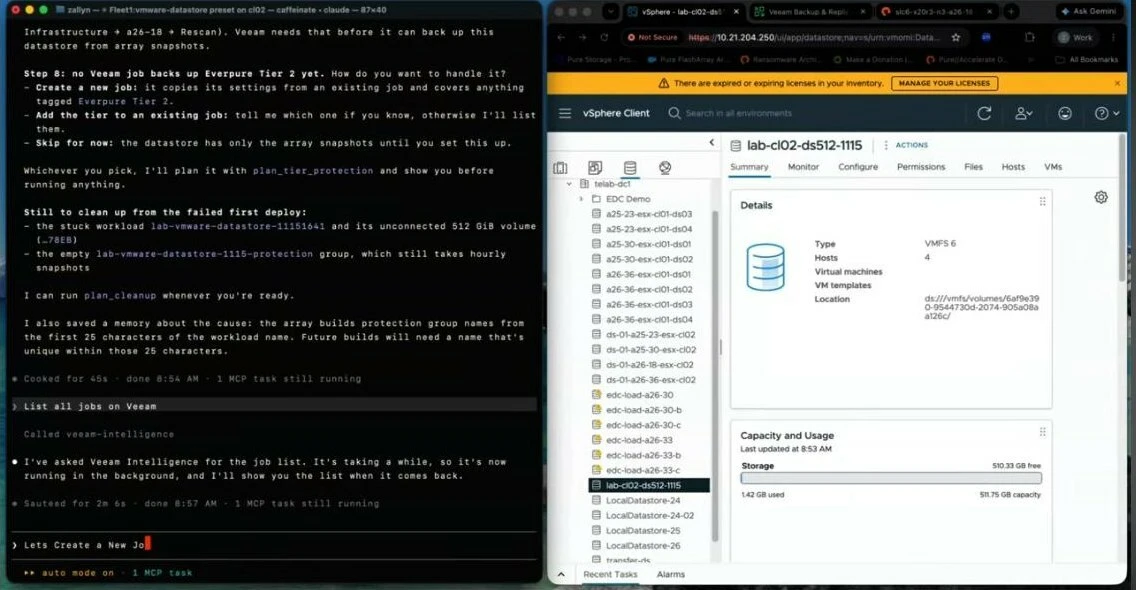
Why tags instead of a datastore-scoped job: flexibility. Tags move with the VM, survive storage moves, and let me layer in things like application-aware processing per tag without rebuilding the job. Datastore scoping is simpler but brittle the moment workloads move. Tags also compose with the rest of your policy: you can scope not just the job but notifications, SureBackup, and copy jobs off the same category.
Where I map the tiers to real infrastructure is the part worth arguing about. In my scheme the higher tiers point at an immutable repository (hardened Linux repo, or object storage with immutability) and a tighter schedule and longer retention; lower tiers get a cheaper repository and a looser RPO. Because the tier is a tag, re-tiering a workload re-homes its backups automatically, including the repository, which is the piece that usually requires a human.
Two operational notes from the run:
- The rescan is the dependency people forget. Until Veeam rescans, a brand new datastore has only array snapshots and the tag-based job will not see the VMs. I force it in the demo; in production you would let the scheduled rescan run ahead of the job window, or trigger it as the last step of provisioning.
- Tag membership decides scope, not SLA. Retention, repository, schedule, and app-aware settings are still yours to define per tier. Get those right once per tier and every future VM inherits them.
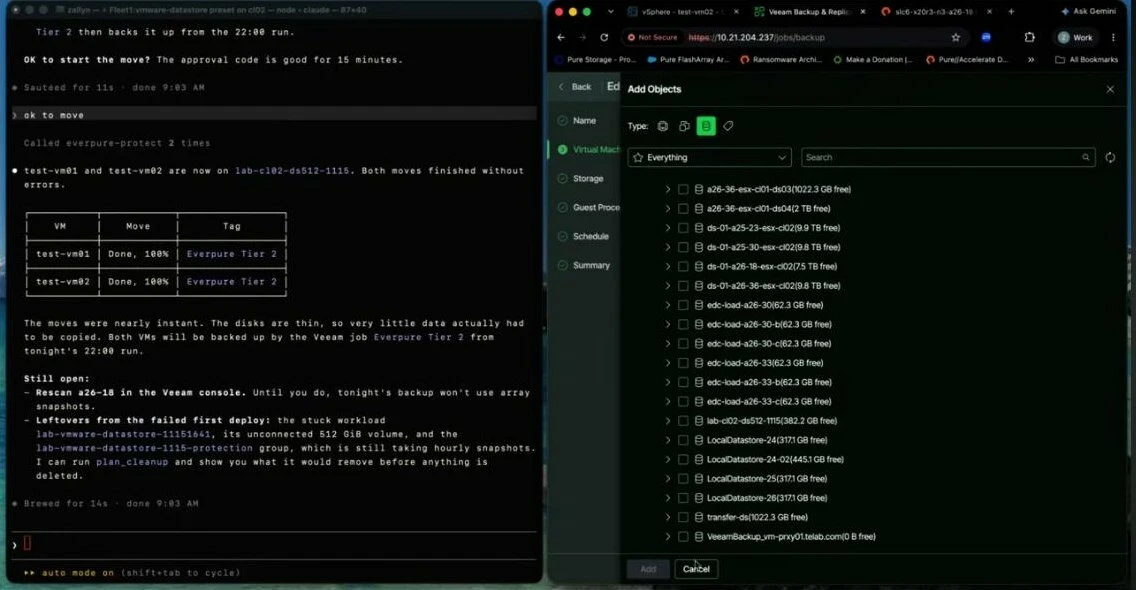
I drove the whole thing through MCP servers (vCenter and Veeam) so it is conversational, with a pre-flight check and an approval gate on every write, and a time-boxed approval code so a walked-away operation cannot fire later. But none of that is required: the Veeam mechanics here are standard tag-based jobs, and you could build the same with your existing automation.
One thing I have not solved to my satisfaction: restore validation per tier. Membership is automatic, but I still want an automated SureBackup or test-restore gate that proves each tier actually meets its RTO. Curious if anyone has wired that in.
Full write-up with architecture and screenshots: https://thebetasociety.com/wcith/pure-storage/everpure-mcp-policy-from-preset-to-veeam-backup/
Video walkthrough: https://youtu.be/FAVeVXPJECo
As always, I am interested in how others of you handle policy-driven membership at scale: tags, datastore scoping, or something at the orchestration layer?