
I have always been intrigued by people on stage.
There was something about the spotlight that pulled me in. Watching someone stand in front of a room, capture attention, tell a story, explain something complex, and make people feel part of the moment fascinated me. At some point, that fascination turned into an itch. I did not just want to watch anymore. I wanted to step into the spotlight myself.
My own journey started internally. I began by giving presentations to colleagues, explaining technology, and later speaking with customers about virtualization projects. That started around 2005. At first, it was not about becoming a stage performer. It was about sharing knowledge, explaining technology, and helping people understand what was possible.
But the real push came when I watched Daniel van Soest and Tony Krijnen doing TechEd Live sessions for Microsoft.
At that time, Microsoft was pushing Hyper-V heavily, and Daniel and Tony decided to have some fun with that. They presented themselves with the stage names Hyper-D and Hyper-T, a playful wink to Hyper-V and the Microsoft marketing around it.
That was exactly what caught my attention.
They were not standing there like suits on a stage, simply delivering information. They brought fun. They brought personality. They told a story. They made technology feel alive.
That was the moment it clicked for me. 💡
I remember thinking, yes, that is what I want to do.
So when opportunities came, I volunteered. First for smaller regional sessions. Then bigger sessions. And eventually, in 2013, I received an invitation to stand on a main stage at VMworld.
That was a very different feeling! 😎
Nervous is normal
People often ask me if I still get nervous.
The answer is yes. Always.
Even after more than twenty years on stage, I still feel nervous when I step into the spotlight. Usually it is the first twenty seconds. Then it fades away and turns into energy.
For smaller stages, I was never extremely anxious. Of course I was nervous, but it was manageable. For a main stage, that was different. I remember not feeling well before going on. A bit nauseous. The pressure was real.
But the moment I stepped on stage, something changed.
The nerves became focus.
That is one of the biggest lessons I learned. Being nervous is not bad. Being nervous means you care. It sharpens you. It gets you focused. It helps you get into the zone. It builds the energy you need.
I once stepped on stage and did not feel nervous at all.
That session crashed and burned. 💥
It was not pretty.
That experience taught me that nerves are not the enemy. They are part of the process. The trick is not to remove them. The trick is to use them.
Stage presence is a profession
In the beginning, I thought presenting was just something you did next to your normal work. A side activity. Something extra.
I do not believe that anymore.
Being on stage is a real profession.
It requires preparation, practice, awareness, reflection, and continuous learning. I am still learning today. I watch how others present. I study different styles. I ask for feedback. I review recordings. I connect with other speakers. I learn from what works and from what does not.
And I try to pay it forward.
When people ask me for advice, I give honest feedback. I help them prepare. I accompany them where I can. I encourage them to step into the spotlight and try.
Because I truly believe many people can be on stage.
But I also tell people something honest. Try it a few times. Do it once, then again, then again. If after five times you still really do not like it, maybe it is not for you. And that is fine.
But often something else happens.
After two or three times, people start to feel the rush. They start to feel that special energy. They start to understand why the stage can become addictive.
Sorry for that. 😉😁
What it means to be a powerhouse on stage
For me, being a powerhouse on stage is not about being the loudest person in the room.
It is about capturing people.
It is about connecting.
It is about dragging people into the story and making them part of the journey. It is about giving them something to think about. It is about educating, sharing knowledge, sharing experience, and giving something back.
When I am on stage, I want people to feel that they are not just listening to information. I want them to feel involved. I want them to feel that the story is alive and that they are part of it.
The best reward is not applause.
Of course applause is nice. But for me, the real reward is when someone comes up after a session and says, “This was not boring. I loved it.” Or when someone shares what they thought. Good feedback, bad feedback, a nod, a thumbs up, or even just a smile. That matters.
That is the connection.
That is why the stage still matters.
Energy goes both ways
I live on the energy that comes from the room.
When an audience gives energy, I give it back. When people are engaged, curious, laughing, thinking, or reacting, it feeds the performance. It creates a loop between the stage and the room.
That is one of the things I love most about being on stage.
I love telling stories and bringing them to life. I love taking a topic and turning it into something people can feel, not just understand. I love the challenge of making a room come alive.
But I also take it seriously.
This is a profession. I want to be the best version of myself on stage. That means I need to keep learning, improving, and evolving.
You are never finished.
Every stage teaches you something.
People want to be entertained
Let me say it clearly.
People want to be entertained.
That does not mean every session needs to be comedy. It does not mean the content is not important. Content matters a lot. But great content delivered without energy, without interest, and without connection will often not land.
You can have the best knowledge in the world, but if you bring it like you do not care, the audience will stop caring too.
Being on stage is so much more than sharing information.
You need to bring the story. You need to bring yourself. You need to give the audience a reason to stay with you. If they are bored, your message may never reach them, even if your content is excellent.
That is why stage presence matters.
It is not decoration. It is delivery. It is connection. It is impact.
Why I am writing this series
Looking back, I would have loved to have someone explain these things to me when I started.
Someone who could tell me what to watch out for. Someone who could help me avoid rookie mistakes. Someone who could explain that being nervous is normal, that feedback is valuable, and that stage presence is something you build over time.
More and more people have started asking me for tips and tricks. So I thought, let me put it on paper. Or in this case, in a blog series.
This series is for people who are new to being on stage or are already seasoned. Maybe you need to present internally. Maybe you want to speak at a community event. Maybe you are preparing for your first conference session. Maybe you are already presenting but want to become stronger, more confident, and more memorable.
My goal is to share what I learned from more than twenty years on stage.
Not theory from a textbook.
Real experience.
The good moments, the bad moments, the lessons, the mistakes, the energy, the nerves, and the growth.
Honest feedback helps you grow
If you are new to the stage, one of my strongest pieces of advice is this.
Find someone you trust who will give you honest feedback.
Not just polite feedback. Honest feedback.
That can be hard in the beginning. Sometimes it feels harsh. Sometimes it hurts. But if it comes from the right person and the right intention, it can help you grow faster than anything else.
I learned this myself.
In the early days of my stage career, I received feedback that I came across as arrogant. That was difficult to hear. I did not like it. My first reaction was not positive.
But then I watched the recording.
And I understood what they meant.
It was not my voice. It was not the words I used. It was my non verbal presence on stage. The way I moved. The way I stood. The way I came across.
That was a wakeup call.
It taught me that presenting is more than speaking. The audience sees everything. Your words, your body, your energy, your attitude, your timing, your facial expression, your silence. Everything communicates.
That feedback hurt, but it helped me.
And that is the type of growth every presenter needs.
If you are nervous, start anyway
If you are nervous, insecure, or afraid to step on stage, my advice is simple.
Start anyway. Just Do It! (borrowed from some sports brand 😉 ) but they are right!
Start small. Present to colleagues. Join a small community session. Practice with people you trust. Ask for feedback. Watch yourself back. Learn from every moment.
Do not wait until the fear is gone.
It may never fully disappear. And that is fine.
The goal is not to become fearless. The goal is to become focused. To become prepared. To become connected. To become better each time you step on stage.
And who knows?
After a few times, you might start to feel that rush. 😇
You might discover that the spotlight 🔦 is not something to fear, but something that helps you grow.
Welcome to the series
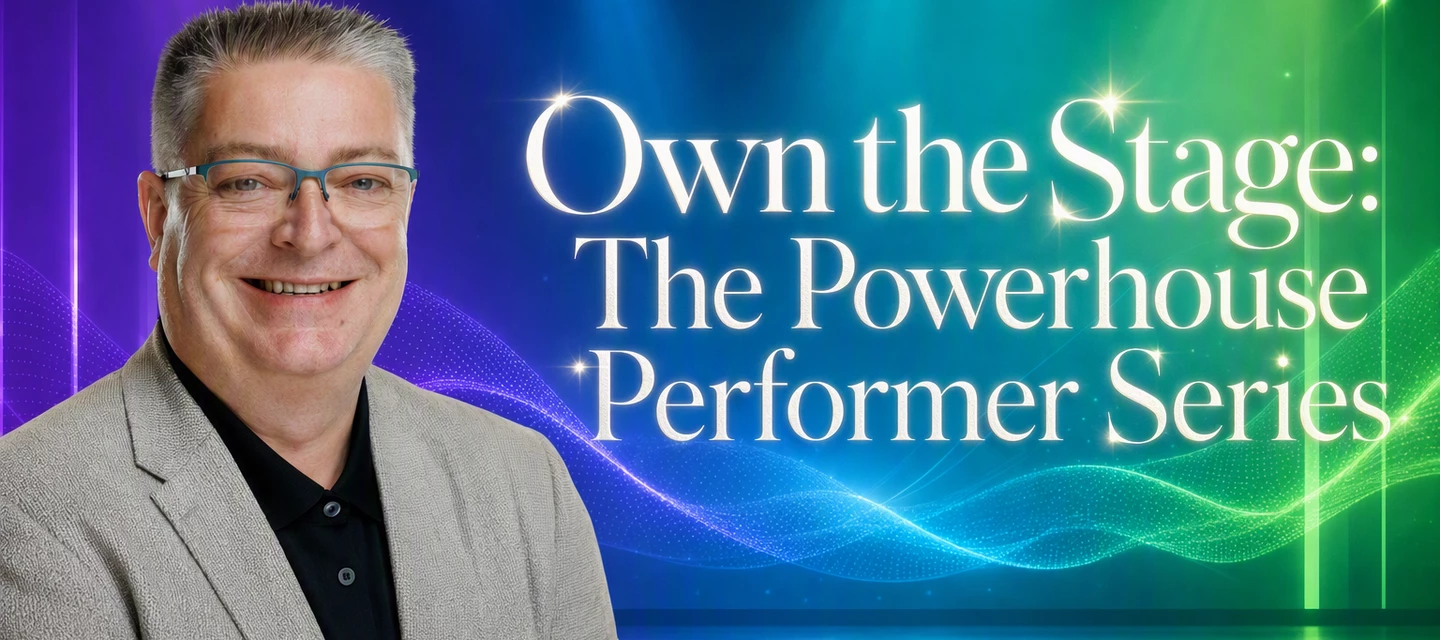
This is why I am starting Own the Stage: The Powerhouse Performer Series.
In the coming parts, we will talk about mindset, audience connection, authentic stage voice, storytelling, strong openings, body language, voice, rhythm, mistakes, preparation routines, and how to connect with the audience in real time.
I do not believe a powerful performer is born in one moment.
A powerful performer is built:
One stage.
One lesson.
One mistake.
One story.
One connection at a time.
Welcome to the journey.