World Backup Day is often treated as a reminder—a checklist item to verify that backups exist, are recent, and are recoverable. But for those of us working in infrastructure and disaster recovery, it represents something much more concrete: the difference between operational continuity and complete outage.
This is not a theoretical discussion. This is a real incident.
This is my experience
- The Incident: Ransomware at Scale
Recently, I was involved in managing a critical ransomware attack that impacted a large virtualized environment. After an initial assessment, it became clear that we were dealing with a full-scale ransomware infection.
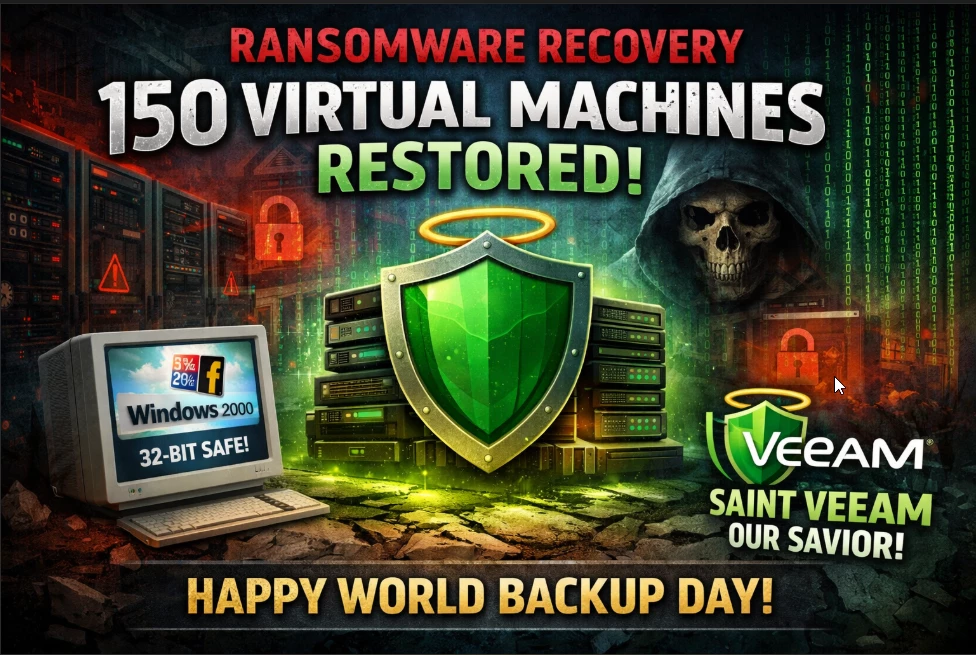
Roughly “150 virtual machines” in a VMware environment were affected. The situation escalated quickly, requiring immediate containment measures. All impacted systems were powered off to prevent further propagation.
At that point, a **war room** was established, and we moved into a structured incident response process:
-Detection & Analysis
-Containment
-Eradication
-Recovery
-Post-Incident Review
- Detection & Analysis
The first phase focused on identifying the scope and behavior of the attack. Indicators pointed clearly to ransomware: encrypted data, compromised systems, and lateral movement across the infrastructure.
A critical observation emerged early:
- Only **64-bit systems were encrypted**
- Legacy **Windows 2000 32-bit machines were untouched**
While surprising, this detail helped confirm the attack vector and refine containment strategies.
- Containment
Containment was immediate and decisive:
- Shutdown of approximately **150 virtual machines**
- Isolation of affected network segments
- Prevention of further spread across clusters and storage
This step was crucial. Without rapid containment, the blast radius could have extended to the entire infrastructure.
- Eradication
Once the environment was stabilized, efforts shifted to removing traces of the attack:
-Identification of compromised entry points
-Verification of clean backup states
-Preparation for controlled recovery
- Recovery: The Real Test
After the first three phases, the real challenge began: **restoring over 150 virtual machines**, including:
-Application servers
-Database systems
-Microsoft clusters
Using Veeam as the backup platform, we initiated a coordinated recovery effort. The restores were executed methodically, prioritizing critical services and dependencies.
Despite the scale and pressure, the process was remarkably smooth:
-No anomalies during restore operations
-Consistent backup integrity
-Reliable recovery points
By 14:00 PM, the entire environment had been successfully restored.
- A Critical Insight
One of the most interesting technical observations was that **legacy 32-bit systems (Windows 2000)** were not affected by the ransomware, while modern 64-bit systems were fully cryptolocked.
This highlights an often-overlooked aspect of cybersecurity:
-Attack vectors are typically optimized for modern environments
-Legacy systems, while risky in other ways, may not always be targeted by newer malware
- Lessons Learned
This incident reinforced several key principles:
1. Backups are not optional—they are survival infrastructure
2.Speed and coordination in incident response are critical
3.Testing restore procedures is just as important as taking backups
4.Segmentation and rapid shutdown capabilities reduce impact
- Final Thoughts
In this case, over 70% of the infrastructure was compromised. Without a reliable backup solution, recovery would have been either impossible or extremely costly.
Veeam performed flawlessly under pressure. It didn’t just help—it **saved the environment**.
On World Backup Day, it’s easy to talk about best practices. But when everything is encrypted, systems are down, and the business is at risk, backup stops being a best practice and becomes your only way out.
So yes—today, we celebrate backups.
And maybe, just maybe:
“Saint Veeam is our protector on World Backup Day.”
Thanks for reading.